

NHTSA Preliminary Evaluation: What Supplier FMEAs Must Show
NHTSA opened a preliminary evaluation into Explorer side airbag burns. What a supplier's DFMEA, PFMEA and field data should show before the request comes.
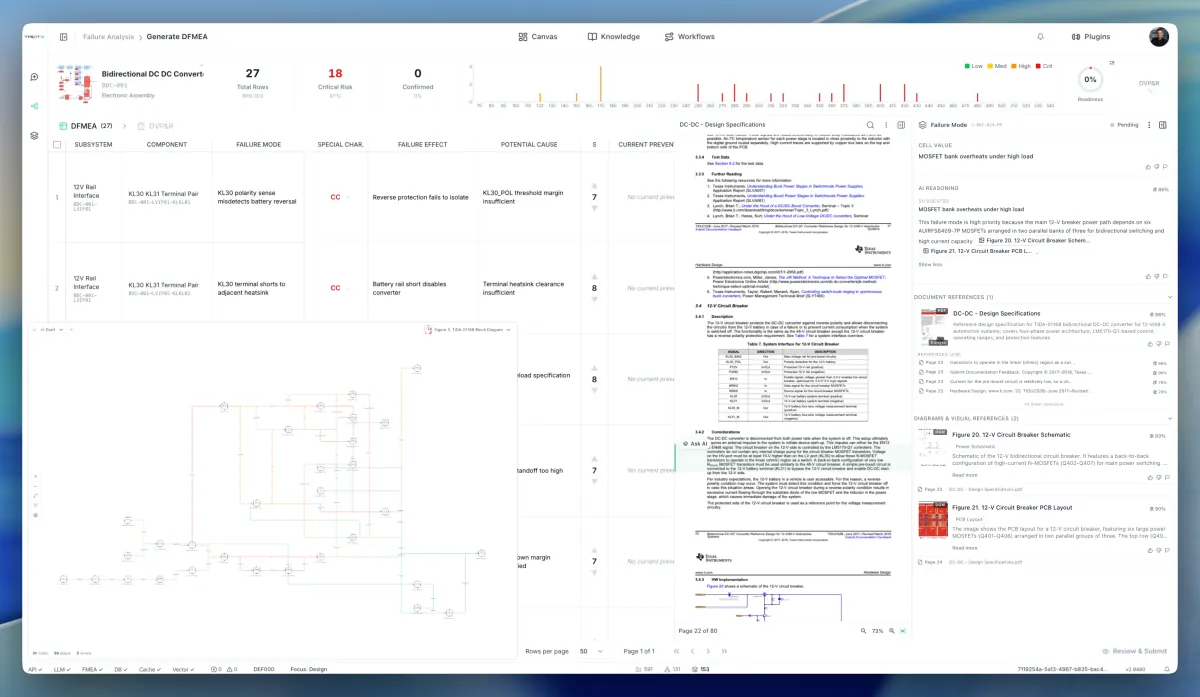
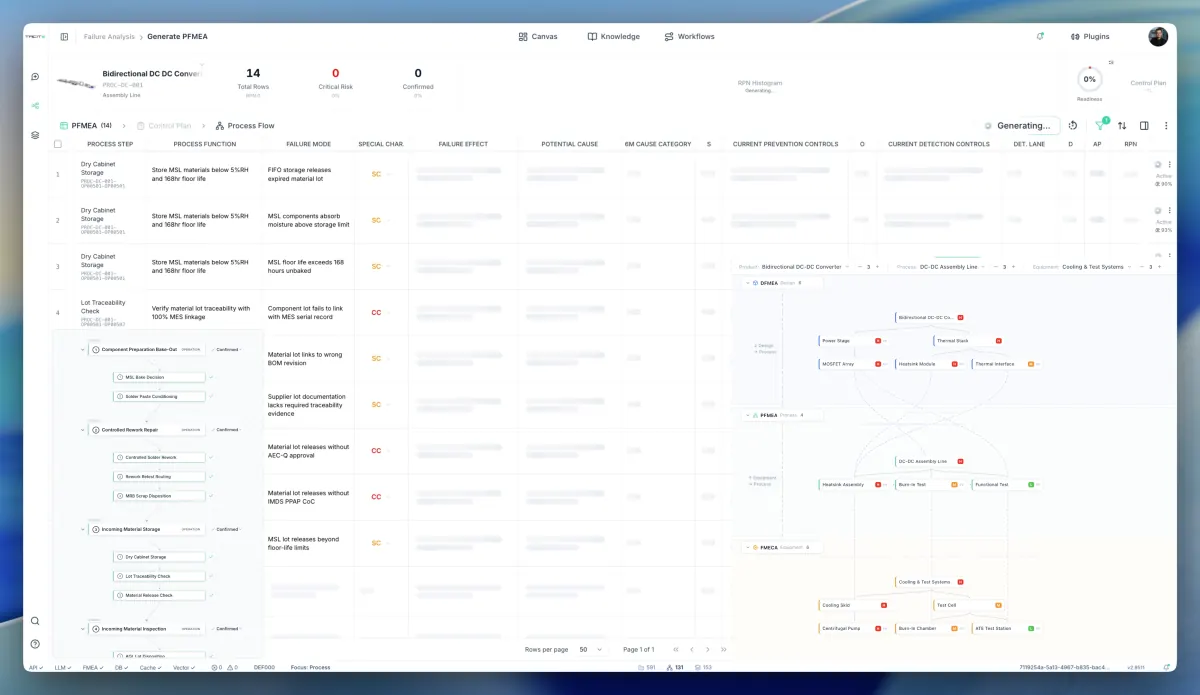
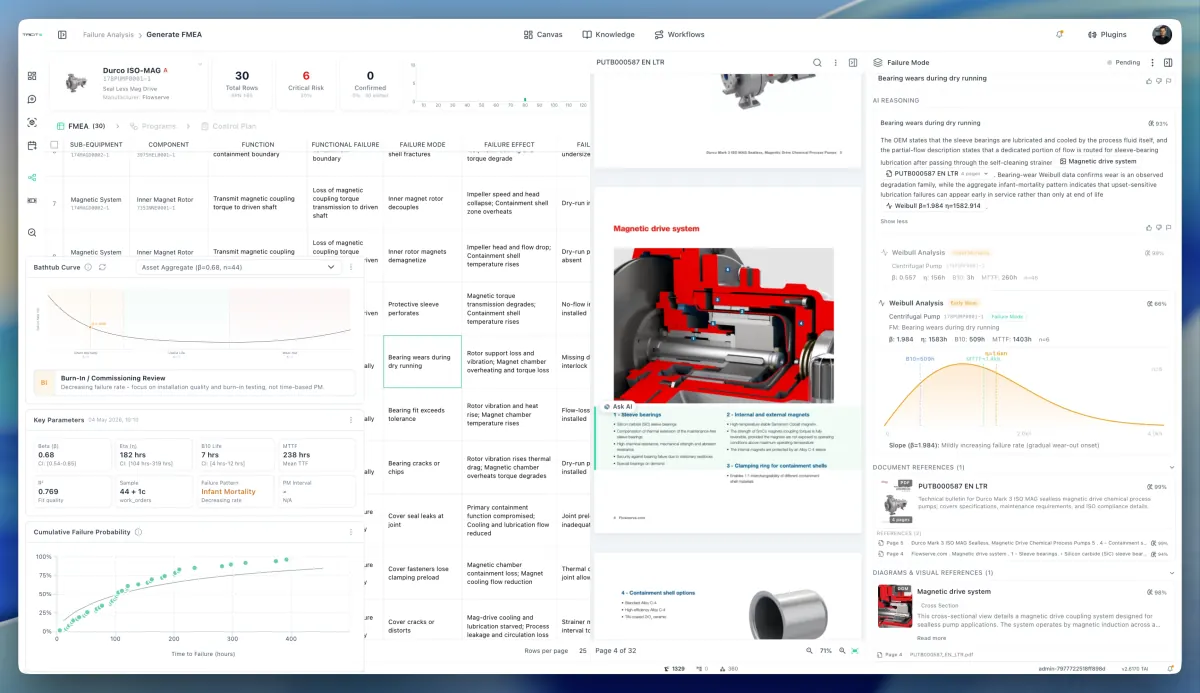
Tacit AI builds and maintains your DFMEAs, PFMEAs, FMECAs and control plans, updating them with every test, defect and failure. Every row traced to its source.
Account live in under an hour. First results in days.
Up to $24 billion. 67 million inflators recalled in the US.
The evidence existed for years before anyone connected it. Takata, 2008-2024.
Reads your 8Ds, tests and failure reports.
Keeps every FMEA current. Learns from every engineer decision.





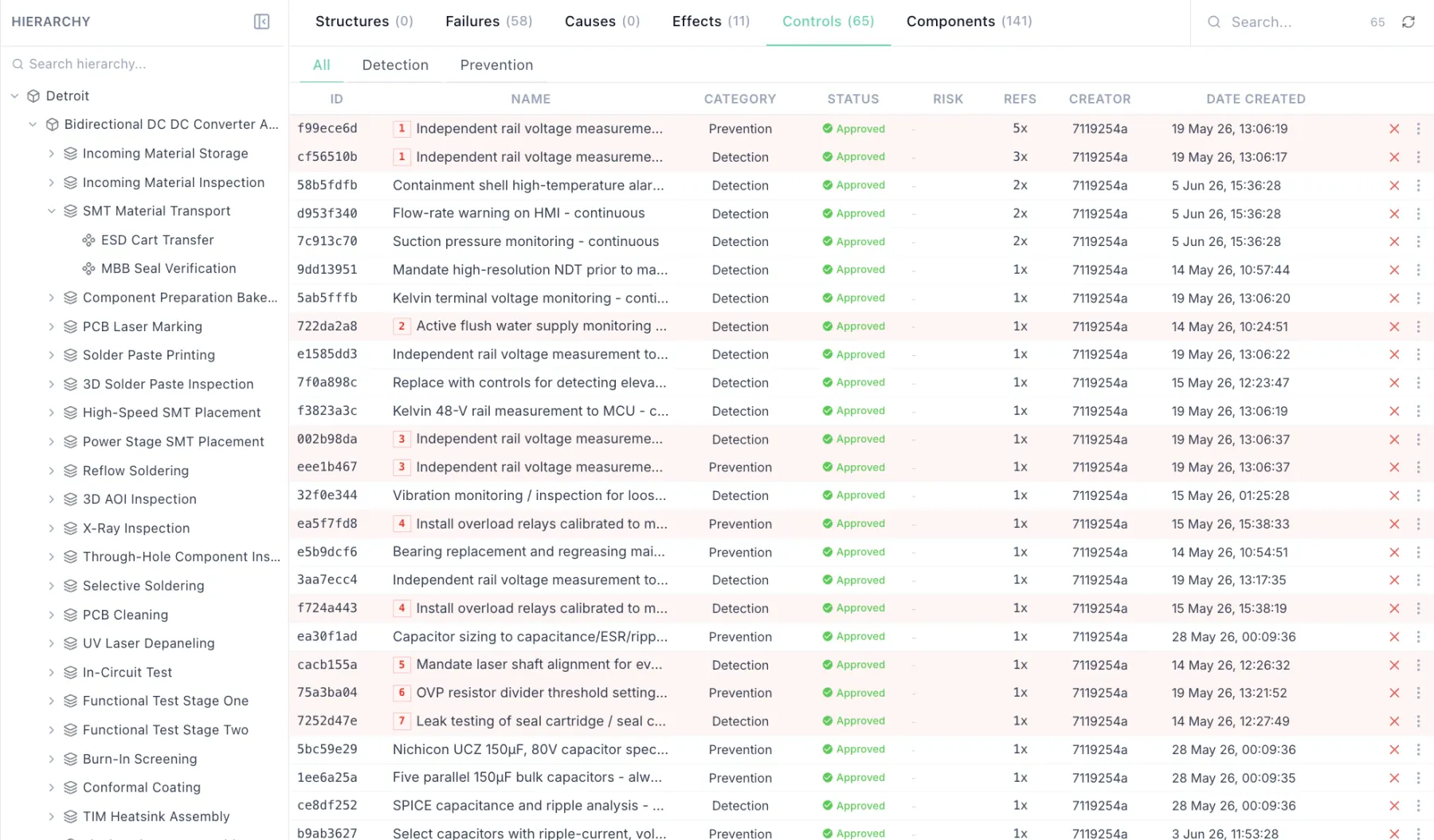 Click to pause
Tacit AI works on top of the tools you already have. Nothing to replace.
It drafts an FMEA, then forgets it. A correction stays in one chat.
Tacit AI keeps every correction and applies it to every related row.
Built around how your engineers work. It still needs an engine.
Tacit AI is that engine, with every capability over API.
APIS IQ, PLATO or Excel holds the FMEA. 8Ds and field data stay outside.
Tacit AI flags the rows your 8Ds, complaints and failure reports change. Your tool stays the record.
Build the master once. Each variant gets its own FMEA from it and stays in step when the master changes.
One FMEA holds every row of every configuration. Options mark the rows only some of them have.
Already have FMEAs? They join the family and keep their own rows.
Choose the options a variant takes. Tacit AI derives its FMEA from the master.
Preview first. You see its rows before it is created.
Change the master and every variant shows what it is missing. Your engineer pulls it in.
Both ways. A row a variant adds can go back to the whole family.
Your cloud, your data centre or fully disconnected. Single sign-on through your identity provider, role-based access, encryption at rest and in transit, US or EU data residency, no prompt retention by default, and your data never trains a model.
Nothing enters a controlled record until your reviewer approves it. Every decision versioned and reversible.
Your VPC on Azure, AWS or GCP, live in days. On-premise or air-gapped. Your LLM gateway or ours.
Every change, citation and decision exportable, logged by user, system and operation.
Failure libraries, corrections and rules stay yours. Export any time and switch models freely.
Every FMEA tool now says AI. 5 levels, from a form that checks your work to a system that builds your FMEA, and 10 questions to ask in any demo.
Read the guide

NHTSA opened a preliminary evaluation into Explorer side airbag burns. What a supplier's DFMEA, PFMEA and field data should show before the request comes.

10 AI tools for FMEA compared on what their AI does, from cell suggestions to full FMEAs built from your own data. Sourced from each vendor, November 2026.

8 FMEA tools checked against what OEMs require: AIAG-VDA, control plan links, foundation FMEAs, MSR-XML exchange and AI, each claim linked to its source.

Which quality tools link 8Ds and customer complaints to the FMEA row? 8 tools compared on complaints, FMEA links, repeat failures, read-across and CAPA.

8 RCM and FMECA tools compared on RCM logic, P-F and Weibull intervals, building from your own data, the SAP PM or Maximo link, and AI.

AI can read your P&IDs. The value comes after: tie each pump, line and valve to the FMECA rows it affects, and flag them when an MOC changes the drawing.

Free FMEA templates in Excel: AIAG-VDA DFMEA and PFMEA with Action Priority built in, an IEC 60812 FMECA and a control plan. Column guide and scoring tables.

Build the business case for FMEA software on 1 page: escapes, coverage, customer requirements, engineering time and downtime, with review time as a cost.

Free AIAG control plan template in Excel. Every column explained, how the PFMEA drives each control, reaction plans and what auditors check.

PM optimization for maintenance leaders: map every PM task to a failure mode, drop and merge tasks, add failure-finding and set intervals from your data.

Which IATF 16949 clauses mandate DFMEA and PFMEA, the 15-point auditor checklist, most common nonconformities, and OEM-specific requirements layered on top.

A 90-day plan to keep FMEA knowledge when your expert retires: paired reviews, the reason in every row, master FMEAs and a test before the last day.

Complete PFMEA for automotive metal stamping. AIAG-VDA 7-step method, 4M cause analysis, Action Priority scoring, and control plan linkage with 10 worked rows.

What AI can build for APQP and PPAP today, what engineers must still decide, what to require, the governance board questions and a 4-week evaluation.

Complete AIAG-VDA 7-step DFMEA for an electric parking brake caliper. Structure analysis, failure modes, Action Priority scoring, and control plan linkage.

An FDA 483 cites your risk management. The first 48 hours, the 15-business-day response, and how to link every deviation and CAPA to the risk file.

AIAG-VDA software must support the 7-step method, Action Priority tables, structure analysis, and DFMEA-to-PFMEA linkage. Evaluation checklist included.

Moving production to a new plant? What PPAP, IATF 16949 and VDA 2 require, how to adapt the mother plant's PFMEA, and what to tell the customer.

Ford, Stellantis, and Renault include Reverse FMEA requirements. GM permits reverse PFMEA or similar methods for proactive annual review. See what the CSRs actually say.

On new business hold? A 90-day plan for VPs and GMs: governance, every plant's FMEAs and control plans, lessons across plants, evidence to lift it.
Drawings, process flow, PFMEA and control plan out of step? The APQP linkage chain, a 1-day audit on 1 part, and the change order that keeps them aligned.

Looking for an APIS IQ-FMEA alternative? Tacit AI builds the full DFMEA, PFMEA and control plan from your documents. Deployed at global OEMs and Tier 1s.

SOP is 12 weeks out and the PFMEAs are not done. A week-by-week plan for launch and quality managers: triage, reuse, run at rate, PPAP, the update.

Excel is the most common FMEA tool and the most common bottleneck. Why teams switch, what alternatives exist, and how to migrate without disrupting your process.

The 3rd 8D on the same failure? Why corrective actions don't stick: missed root causes, unverified fixes, no read-across, and a 12-month 8D review.
APIS IQ, PLATO e1ns, Teamcenter, Windchill, Relyence and Tacit AI side by side: AIAG-VDA support, AI features, control plans and deployment, in 1 table.

IATF 16949 major on your FMEA? You have 15 days to respond and 60 to close. What the auditor expects: containment, root cause of the system, plan, proof.

After a recall, the root cause almost always traces back to an inadequate FMEA. Learn how to rebuild with source traceability and defensible risk analysis.

8Ds closing without touching the PFMEA? Map each complaint to its failure mode and cause, re-rate from the evidence, and prove the loop is closed.

ISO 13485 requires risk management throughout the product lifecycle. DFMEA requirements for medical devices, template structure, severity scales, and what auditors check.

In controlled shipping? What CS1 and CS2 mean, the first 48 hours, the exit criteria to get in writing, and the PFMEA and control plan fixes to stay out.

ChatGPT generates text. Tacit AI builds reliability programs. The difference is persistent industrial memory, engineer feedback loops, and knowledge that compounds.
Your customer rejected the PPAP. A 30-day plan for quality leaders: contain, find the real gap, fix the PFMEA and control plan, and resubmit with evidence.

AI detects patterns across incidents, suggests causal chains, and analyzes free-text work orders. Learn how human-AI collaboration improves RCA.

Compare the 4 most common RCA methods. Learn when to use each, how they differ in complexity and rigor, and how to avoid common investigation mistakes.

FDA’s QMSR is effective and incorporates ISO 13485 requirements. Learn what medical-device teams should review in their risk-management and FMEA workflows.

Incomplete work orders break FMEAs, RCA, and maintenance strategies. Learn the 20+ dimensions of data quality and practical steps to fix your CMMS data.

AI cuts FMEA creation from weeks to days. Learn how document intelligence, failure mode extraction, and automated scoring change the workflow.

Most FMEAs are still done in Excel. Why spreadsheet-based FMEA fails at scale and what modern teams are doing differently in 2026.

A 10-step tutorial for Design FMEA covering scope, structure, failure modes, scoring, and actions. Includes a hydraulic valve walkthrough and AI tips for each step.
What Ford's November 2026 CSRs require of supplier FMEAs for PPAP: AIAG-VDA format, foundation FMEAs, FMEA software and approvals.
RPN = Severity × Occurrence × Detection, each rated 1 to 10. Free calculator for RPN and AIAG-VDA Action Priority, with rating tables and worked examples.

DFMEA focuses on design, PFMEA on process, and FMECA adds criticality. Learn when to use each type and how to choose the right one.

FMEA is a structured method to identify potential failures before they occur. This guide covers the process, standards (AIAG-VDA, IEC 60812, ISO 14971), worksheet structure, common mistakes, and how AI is changing FMEA.
One system. Your data. Results in days.
“We evaluated Tacit AI for Design FMEA on a critical subsystem. The structured output and the approach to connecting information exceeded expectations.”
Design Engineer, Top 10 Global OEM, DFMEA, Europe