

Run to Failure on a Safety System: What the CSB Found at Bio-Lab Conyers
On 29 September 2024 a warehouse at the Bio-Lab plant in Conyers, Georgia, held nearly 14 million pounds of pool-treatment chemicals that react with water. Water reached them. Roughly 17,000 people were evacuated, local media reported that 90,000 people were told to shelter in place, and the warehouse was destroyed. No injuries were reported (CSB report, p. 7, 9).
The US Chemical Safety Board (CSB) published its final report on 21 July 2026. Its cause statement is 1 sentence: “a corroded sprinkler system component that failed, allowing water to contact the stored pool-treatment chemicals” (CSB report, p. 11). This post is for the reliability, maintenance and process safety leaders who own a protective system. It lays out the warning signs in the order the record shows them, and the risk row they should have changed.
The short version
- The safety system was the source. The sprinklers that protected the oxidizers released the water that started the reaction.
- The warnings were in the plant’s own records: inspection findings, flow alarms and repair tickets, years before the fire.
- The last formal inspection, 17 days before, recorded no corrosion. The repair tickets in the same weeks said otherwise.
- The CSB found that “Bio-Lab had never performed any formal hazard analyses of the storage warehouse” (CSB report, p. 115).
What the CSB Found
The CSB names run to failure as a safety issue in its own right: “Most incidents are preceded by warning signs related to asset integrity. The Bio-Lab Conyers facility did not proactively maintain its corroding sprinkler system in the warehouse” (CSB report, p. 9).
- The mechanism. Chlorine fumes from the stored chemicals formed acid droplets on metal surfaces such as sprinklers and fire piping, and the acid corroded them (CSB report, p. 120).
- The practice. Heads were replaced “only after they had corroded, failed, and begun to leak” (CSB report, p. 120).
- The counterfactual the CSB states. “Had Bio-Lab Conyers taken steps to proactively prevent sprinkler system leaks instead of allowing the system to run to failure, the incident likely would not have occurred” (CSB report, p. 120).
- The interval never moved. The CSB found no evidence of “increasing the frequency of inspection or maintenance” on the sprinkler system after the findings (CSB report, p. 80).
Sprinklers do not look like process equipment. The CSB is explicit that they count: they “fall within the definition of ‘asset integrity’ as they prevent or mitigate the consequences of a release of hazardous materials” (CSB report, p. 78).
The Signal Timeline
Every entry below comes from the CSB report. The mint marks are the points where a risk row that reads the plant’s own records changes: a new exposure, a repeat failure, a finding at scale, a run of repairs.
- 30 Dec 2019About 2 months after oxidizer storage began, “bolts on the fire water piping corroded through.” It was the warehouse’s first sprinkler component failure (CSB report, p. 61).
- Nov 2021 and Dec 2022The annual sprinkler inspections record corrosion on 560 heads inside the oxidizer bunker. Those heads are replaced with corrosion-resistant ones in November 2022 (CSB report, p. 64).
- 2021 and 2022The insurer’s risk assessments find widespread sprinkler corrosion in 4 other buildings on the site. The second report repeats the first (CSB report, p. 62, 93).
- During 2023Inventory grows and oxidizers are stored outside the bunker as well, where the heads were never upgraded to corrosion-resistant ones (CSB report, p. 8, 79).
- 5 Jul and 10 Aug 2023Flow alarms in the zone next to the bunker. The second comes from “the blowout of a 2-inch pipe coupling” (CSB report, p. 67-68).
- 28 Dec 2023The annual inspection records “widespread corrosion of 1,124 sprinkler heads outside the bunker” across 4 of the 7 zones. The decision: replace each head in kind “as they developed a leak” (CSB report, p. 66).
- Jul to Sep 2024A hole in the fire piping is repaired on 16 and 17 July. Corroded heads are replaced on 13 September and again from 17 to 20 September. On 17 September a leak is controlled “with a bucket” (CSB report, p. 68, 79).
- 12 Sep 2024The 5-year inspection “did not record any corrosion” (CSB report, p. 78).
- 29 Sep 2024A corroded sprinkler component fails and water reaches the stored oxidizers just outside the bunker (CSB report, p. 8).
No single entry was hidden. They sat in different places: an inspector’s report, an alarm log, a repair ticket, a chat message. The fire alarm logs alone show abnormal status on “at least 60 of the 637 calendar days” from January 2023 to the fire (CSB report, p. 66).
The Row That Should Have Moved
Below is a typical equipment FMEA row for this system, built only from facts in the CSB report. It is an illustration, not Bio-Lab’s analysis. The CSB found no formal hazard analysis of the warehouse existed.
| The row as written | The row kept up to date | |
|---|---|---|
| Item | Sprinkler system over oxidizer storage | Same |
| Function | Hold water until a fire calls for it | Same |
| Failure mode | Water released with no fire: a leaking head, coupling or pipe | Same |
| Effect | Water reaches water-reactive oxidizers: decomposition, toxic gas, fire | Same |
| Cause | Corrosion of heads and piping | Corrosive vapors from the stored oxidizers, now outside the bunker too |
| Prevention control | Annual inspection, replace a head when it leaks | Corrosion-resistant heads and piping in every zone that holds oxidizers |
| Detection control | Visual check once a year | Every flow alarm, impairment and repair ticket matched to this row as it is logged |
| Evidence | None linked | 1,124 corroded heads, 3 flow alarms, repair tickets from July to September |
| Severity (S) | 10 | 10 |
| Occurrence (O) | 3 | 8 |
| Detection (D) | 5 | 7 |
| Action priority | Medium | High |
The left column is how this row is usually written on day 1. The right column is the same row after the evidence in the timeline is linked to it. Occurrence goes from rare to repeated, detection from an annual visual check to every log entry, and the action priority goes from Medium to High. A High row needs an action or a documented reason, and corrosion-resistant heads across every oxidizer zone is the obvious action.
Why the Evidence Never Reached the Risk Row
- The inspection was the only formal input, and it missed. The 5-year inspection on 12 September 2024 recorded no corrosion. Corroded heads were replaced the next day (CSB report, p. 68, 78).
- The real signal lived in tickets and logs. Repairs, flow alarms and impairments were recorded, but nothing joined them to a risk assessment. The CSB notes that not every leak even reached the alarm logs, so the failure rate was likely higher than the logs show (CSB report, p. 68).
- The change had no risk review. Moving oxidizers outside the bunker put them under heads that were never upgraded. The CSB found no evidence of an adequate hazard assessment before that decision (CSB report, p. 83).
- The lesson was already on file. In 2020, rainwater from Hurricane Laura reached the same type of chemicals at Bio-Lab’s Lake Charles plant (CSB Lake Charles report). The CSB says the company had the chance to learn from 2 earlier Bio-Lab incidents within 5 years of the Conyers fire (CSB report, p. 10).
How a FMECA That Stays Up to Date Handles the Same Signals
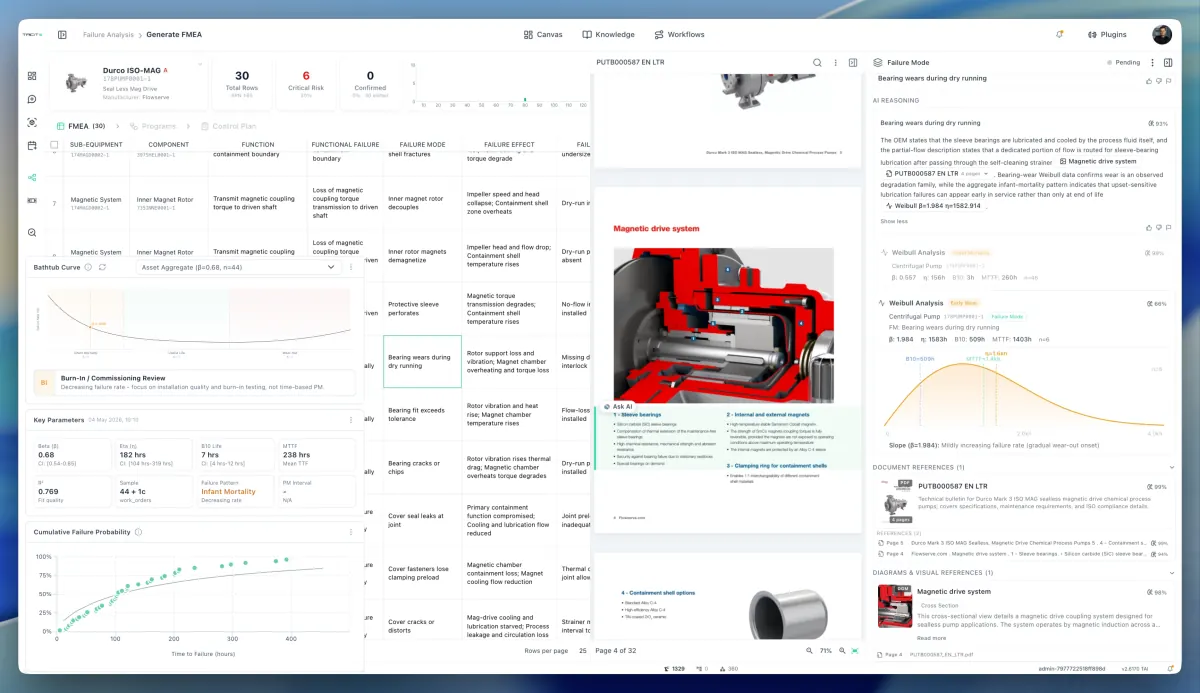
- Build the row from what you own. Tacit AI builds the FMECA from manuals, drawings, inspection reports and work order history, every row traced to its source. Setup in hours, the first FMECA in days.
- Match every record to its row. A repair ticket for a leaking head, a flow alarm, an impairment, an inspection finding: each is matched to the failure mode it is evidence of, the day it is logged.
- Move the ratings with the evidence. When repeat failures contradict an occurrence rating, Tacit AI proposes the new rating and the action it triggers, with the records behind it.
- An engineer decides. The owner approves or rejects each change, and the decision is recorded with its evidence. Weibull and P-F intervals are recomputed from the failure history, so the inspection interval moves too.
Check Your Own Plant This Week
- List every protective system: sprinklers, deluge, relief valves, interlocks, detectors. Each needs a row for failing to act and a row for acting when it should not.
- Pull 24 months of repair tickets and alarm logs for those systems. Count the repeats per failure mode.
- Compare each count with the occurrence rating on the row. Any row with repeats and an unchanged rating is a gap.
- For every change in storage, layout or inventory since the last review, check that the rows for the systems above it were reviewed.
- Check that a finding at scale (hundreds of corroded heads, a failed coupling) opened an action with an owner and a date, not a replace-on-failure rule.
Safety system on run to failure?
Get the PM review sheet: map each task to the failure mode it prevents, including the failure-finding tasks on protective systems.
We email you the PDF. No newsletter. Privacy policy
Bring 1 protective system and 2 years of its work orders. Book a working session and see its FMECA built from them, with every repeat failure linked to its row.
Frequently Asked Questions
What caused the Bio-Lab Conyers fire?
The CSB found the cause was “a corroded sprinkler system component that failed, allowing water to contact the stored pool-treatment chemicals”, which started a decomposition reaction, toxic gas release and fires on 29 September 2024.
How many corroded sprinkler heads were found before the fire?
The December 2023 annual inspection recorded corrosion on 1,124 sprinkler heads outside the bunker, across 4 of 7 zones, 9 months before the fire. Earlier inspections had recorded 560 corroded heads inside the bunker.
What does run to failure mean for a safety system?
It means a component is replaced only after it fails. For a protective system such as a sprinkler, the failure can be the hazard itself. The CSB found that Bio-Lab replaced heads only after they had corroded, failed and begun to leak.
Was anyone injured at Bio-Lab Conyers?
No injuries were reported. Roughly 17,000 people were evacuated, Interstate 20 was closed, and the CSB puts property damage at $50.5 million.
How does Tacit AI keep a FMECA up to date?
Tacit AI matches work orders, alarms and inspection findings to the FMECA rows they are evidence of, proposes new ratings and actions when the evidence contradicts a row, and records each engineer’s decision with its source.
Sources
- Chemical Decomposition, Fires, and Toxic Gas Release at KIK Consumer Products / Bio-Lab Conyers Facility, investigation report No. 2024-04-I-GA, US Chemical Safety Board, July 2026
- Chemical Reaction, Decomposition, and Toxic Gas Release at Bio-Lab, Inc., investigation report No. 2020-05-I-LA, US Chemical Safety Board, April 2023