Design Engineering

DFMEAs that update when
field data proves them wrong.

Engineer-reviewed, source-traced, linked to PFMEA and field evidence. The risk model stays current as your product evolves.

Referenced results your engineers can defend.


TacitAI Design Engineer — DFMEA workspace

TacitAI Design Engineer — DFMEA workspace


Results from current design & DFMEA deployments

70–90%
engineer-ready on first draft
Production deployments
83%
data quality improvement
Top 20 OEM deployment
Live
updates from field evidence
Production deployments
100%
traced to specs & test data
All deployments
IATF / PPAP
audit-ready, AIAG-VDA format
All deployments

The Gap

The DFMEA is done. The risk isn’t.

Field data arrives every day. None of it reaches your risk analysis.

80% of field signals never reach the DFMEA. The same failure modes pass through to production. Again.


01
“500 components – how do I map them all?”

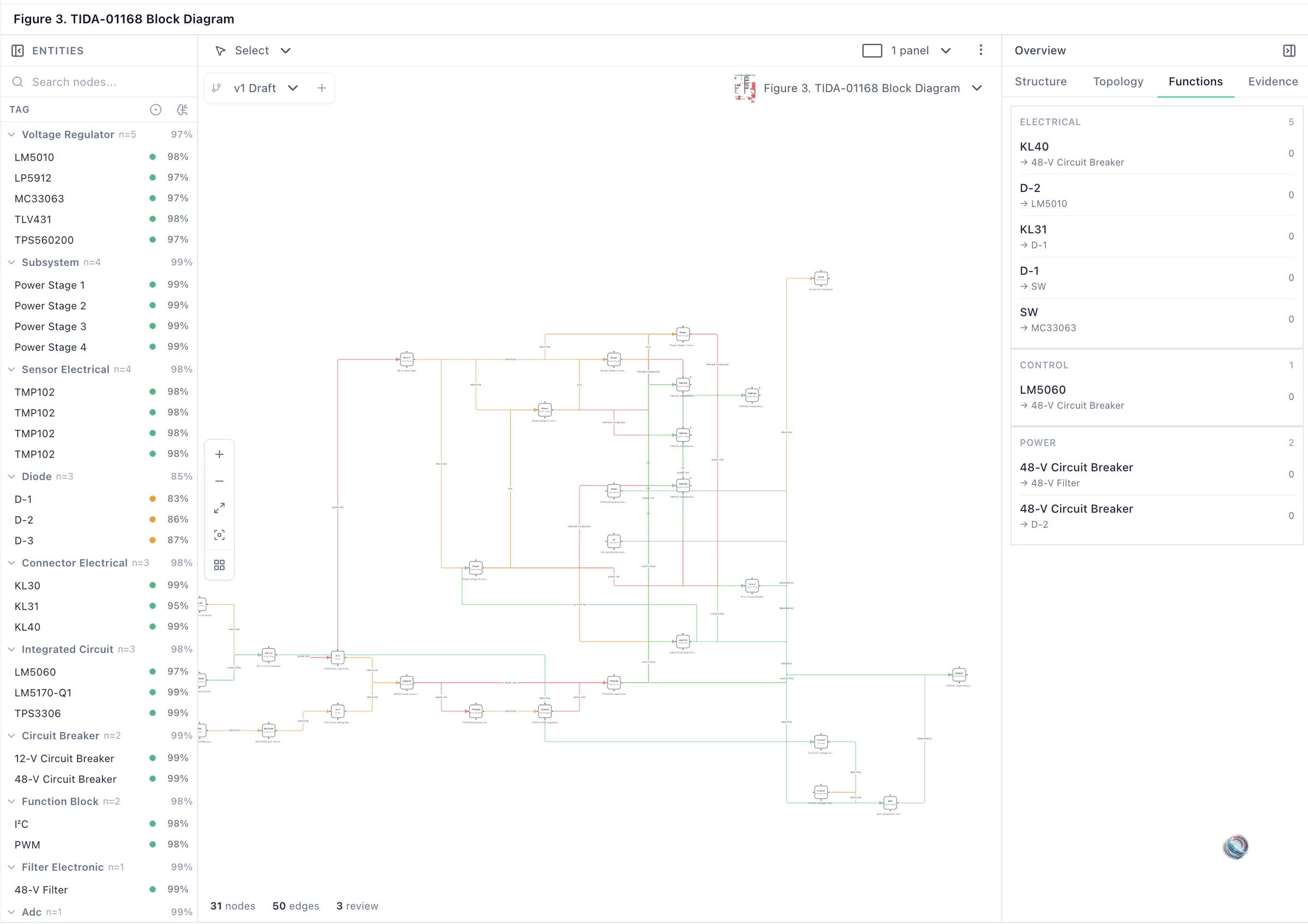
Product hierarchy from your BOM. Requirements traced to every component.

Import from Teamcenter, Windchill, or Excel. Product to part level with SC/CC/HIC classification, requirements traceability, and interface identification. Upload supplier FMEAs and we map their failure modes against your hierarchy. Gaps flagged before SOP. Every FMEA row traces to its source paragraph — Ford’s updated CSRs and the AIAG-VDA transition require traceable evidence, and every row we generate ships with it.

BOM Import
SC/CC/HIC Classification
Requirements Traceability
Supplier FMEA Matching

Product hierarchy with BOM import and requirements traceability

02
“What can fail, and what flows downstream?”

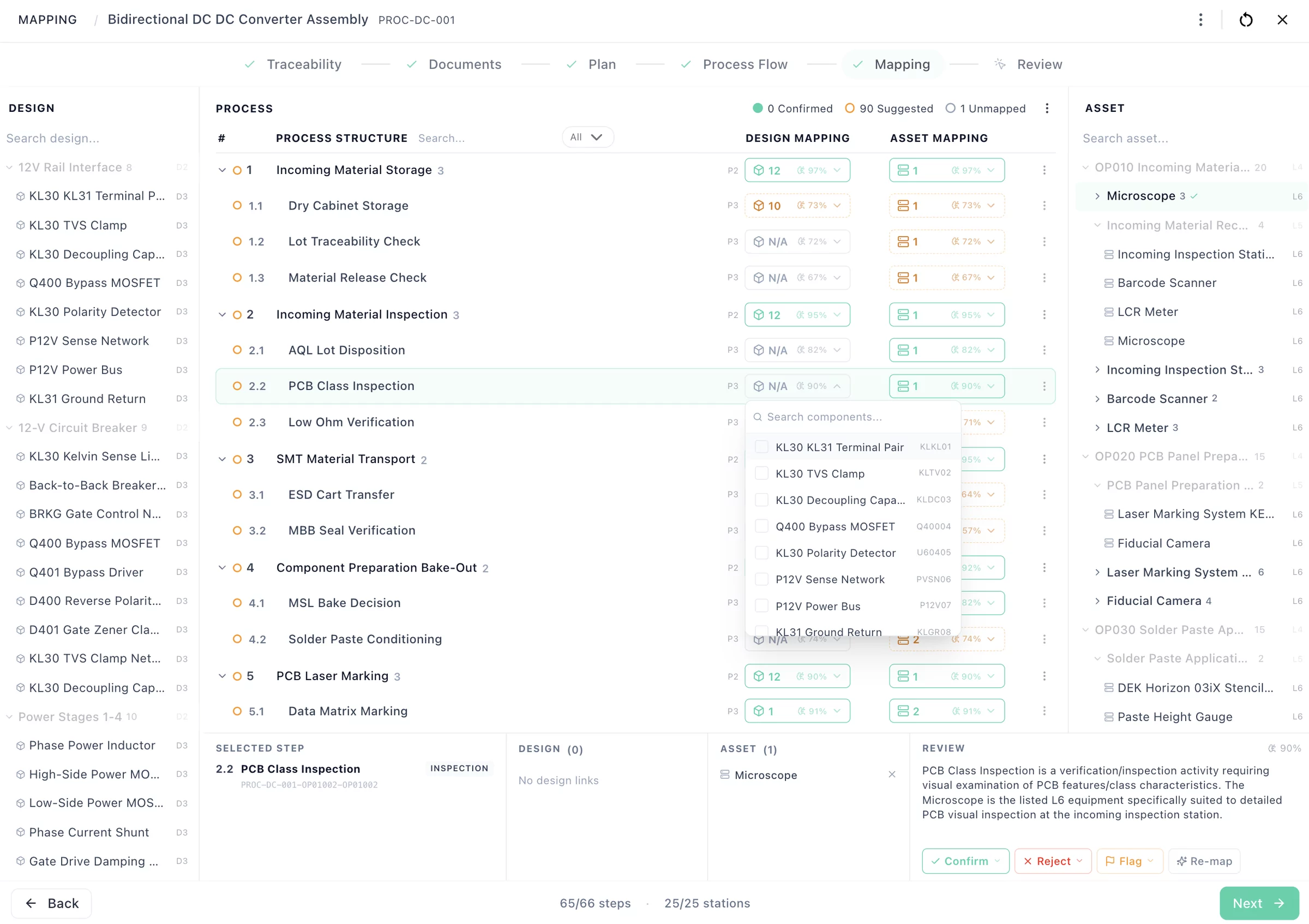
DFMEA to PFMEA to control plan. One chain, fully linked.

Failure modes mapped against requirements, materials, geometry, and interfaces. Design severity flows into PFMEA. CC/SC/HIC classifications chain through to control plan columns. DVP&R with Kanban tracking. AIAG-VDA native with AP scoring and RPN for legacy. Upload existing FMEAs to validate coverage and consistency.

DFMEA & SFMEA
DFMEA → PFMEA → Control Plan
FMEA Verification
AIAG-VDA Native

Design-to-process-to-asset mapping with component traceability and confirmation workflow

03
“Update severity to 8 for all thermal failure modes.”

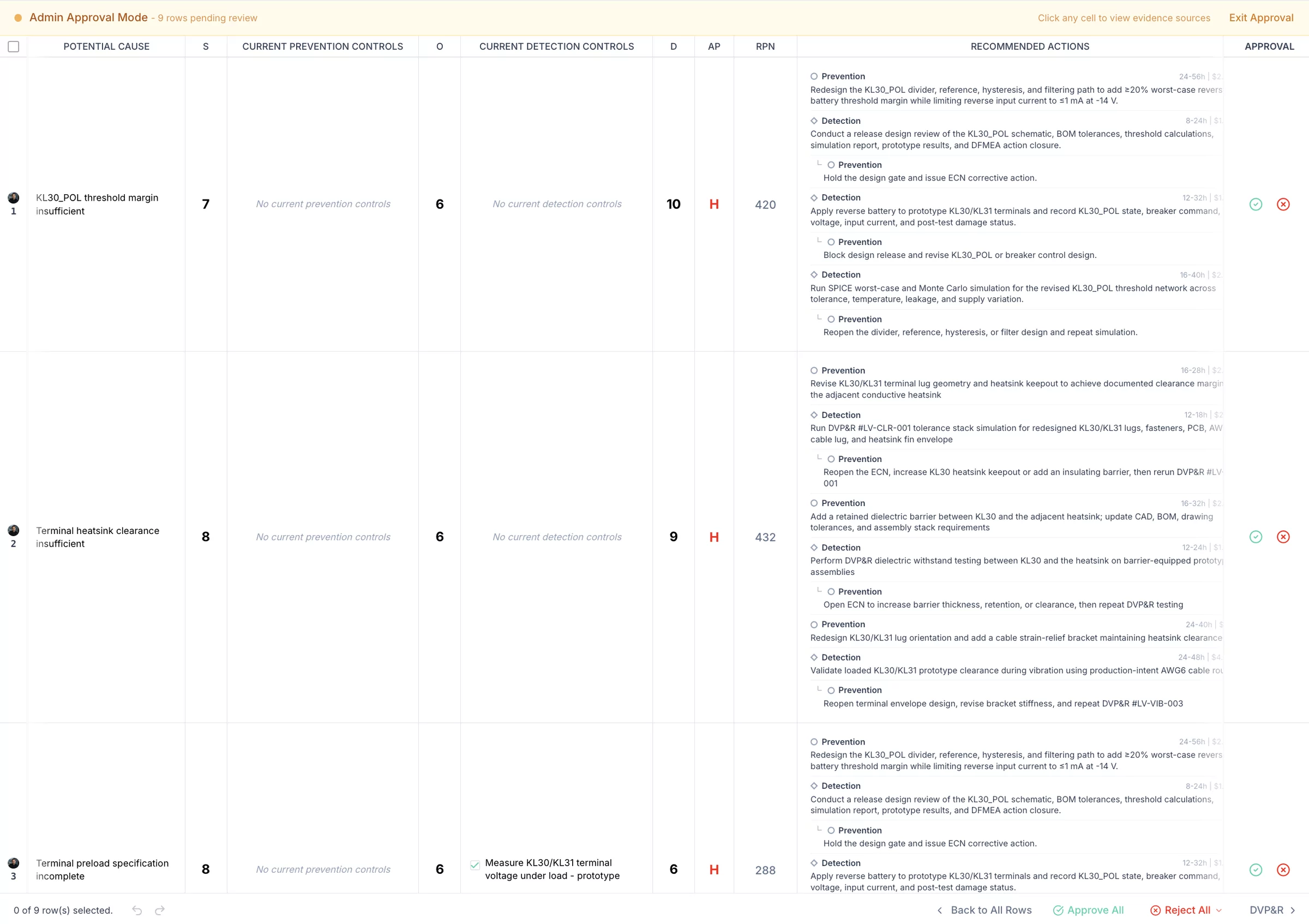
Propose changes, review each one, approve or reject.

Ask a question, get cited answers. Ask for a change, the AI proposes specific cell updates with reasoning. Each change has its own approve/reject button. Nothing writes without engineer sign-off. 34 languages.

Command Blocks
Per-Row Approve/Reject
Cited Answers
34 Languages

AI companion with per-row approve and reject workflow

04
“How does my DFMEA connect to PFMEA and control plan?”

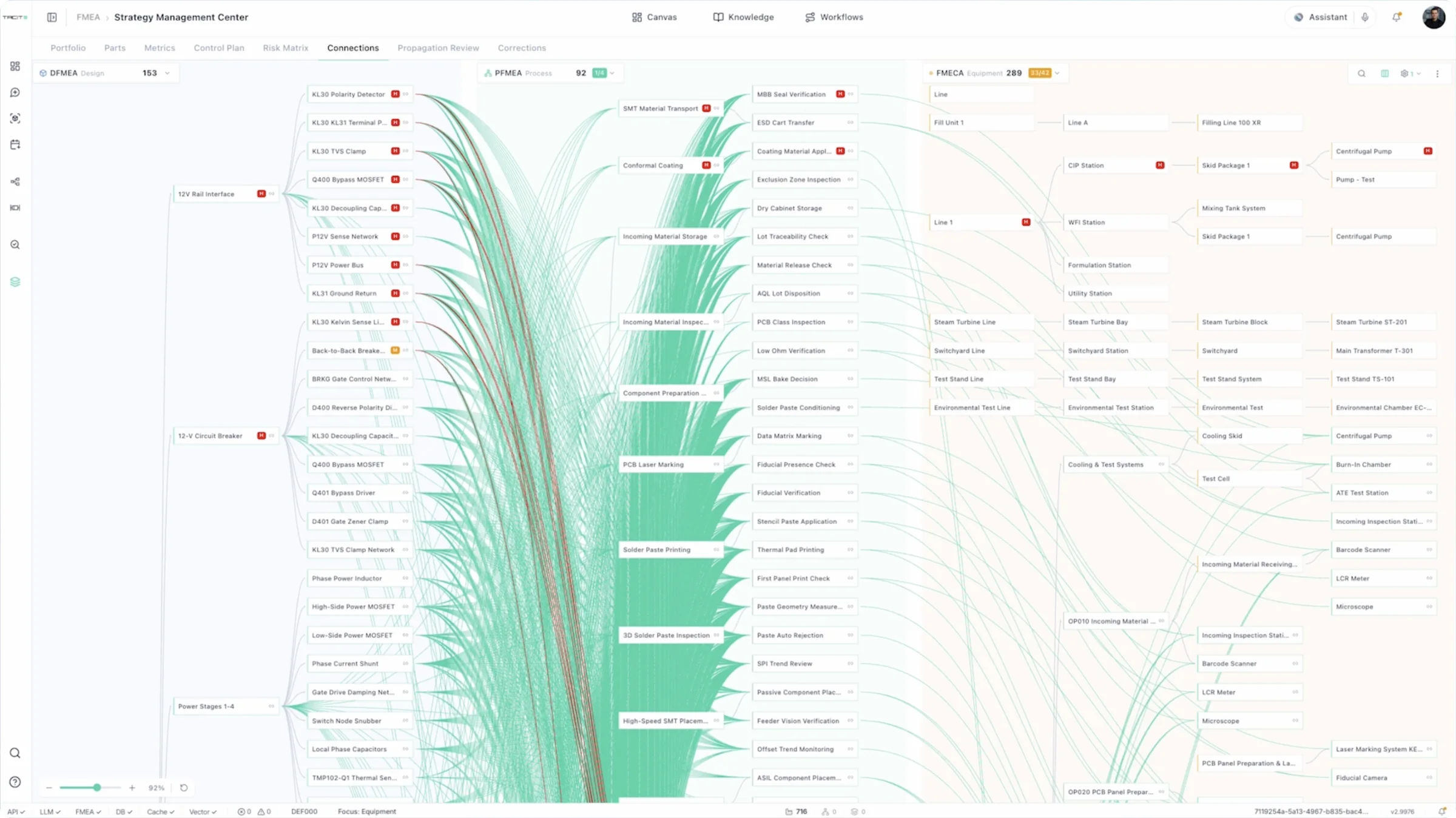
Three-lane canvas. DFMEA, PFMEA, FMECA – all connected.

Three lanes showing how design failure modes flow into process controls and field strategies. Click any connection to see what links them. Design changes flag downstream PFMEAs and control plans automatically. Regressions detected from field data.

DFMEA → PFMEA → CP
Visual Connections
Change Propagation
Regression Detection

Connections canvas – DFMEA to PFMEA to control plan

05
“We use the same steering column in 3 platforms. Do I update each one?”

Confirm it once. Every variant inherits.

Confirm FMEA rows for a component and they become a reusable template automatically. The next product using the same component inherits everything. Update a template and every variant is flagged. Family View shows deltas across all products side-by-side.

Component Library
Template Auto-Build
Push Propagation
Family Delta View

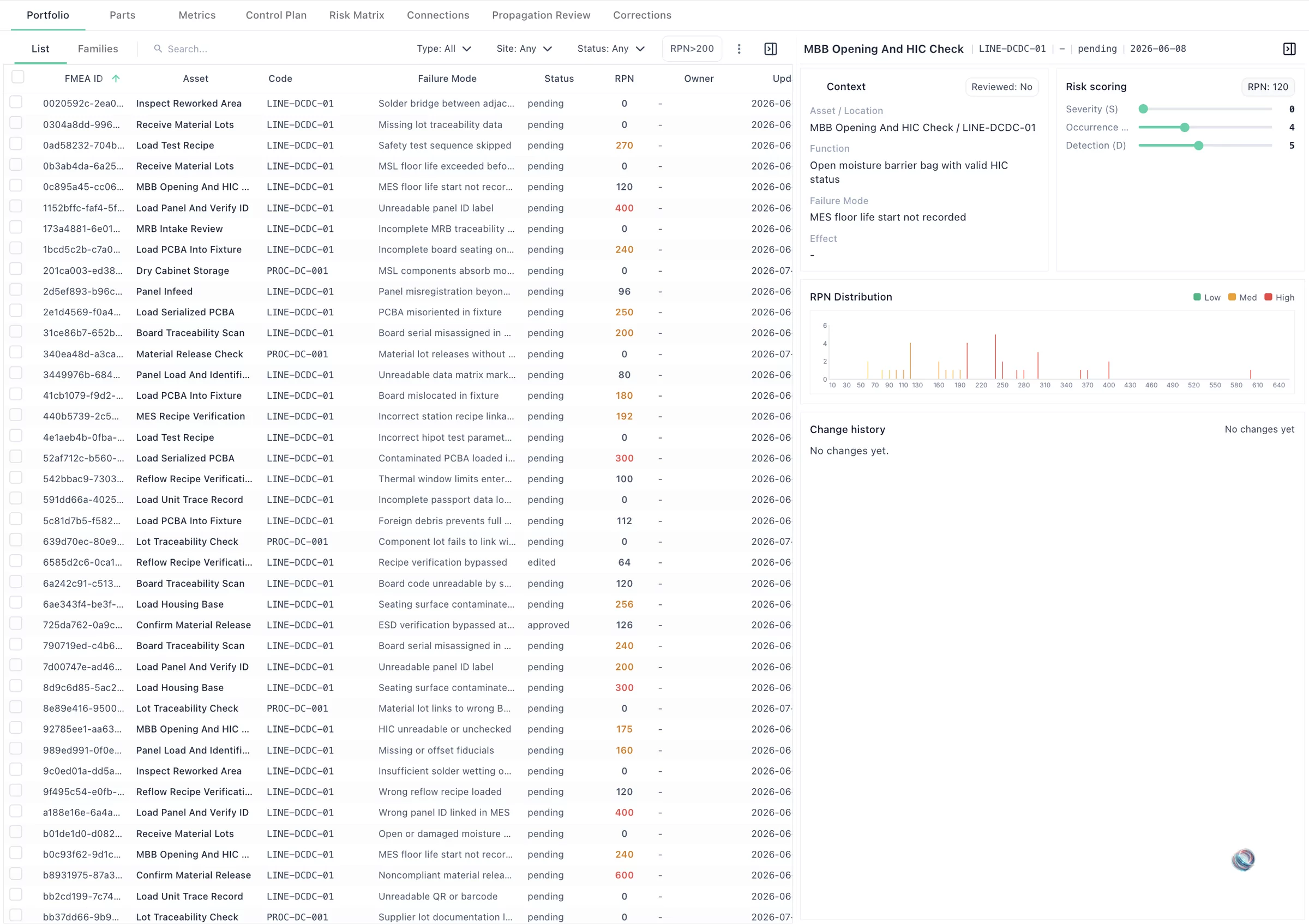
Component template library with FMEA portfolio, families, and propagation view


What You Get

See the design risks your current analysis doesn’t cover.

DFMEA

Engineer-Ready DFMEA

70-90% complete. AIAG-VDA compliant with Action Priority (AP) and RPN scoring. Design requirements, characteristics, and mechanisms mapped. All rows traceable to source.

SFMEA

SFMEA with Interface Mapping

System-level failure modes across subsystem interfaces. Cascading effects, signal integrity, and protocol risks identified.

DVP&R

DVP&R with Kanban Tracking

Every DFMEA row linked to verification activities. Kanban view: planned, in-progress, passed, failed. Coverage metrics per component. Pass/fail status per test method. Test plans aligned to risk priority.

SC/CC

SC/CC/HIC Classification

Critical, significant, and high-impact characteristics assigned from failure mode severity per AIAG-VDA. OEM-specific symbol mapping. Flows from DFMEA through PFMEA into control plan entries.

Diagrams

Boundary & Interface Diagrams

Structure analysis diagrams generated from your BOM and specs. System boundaries, component interfaces, and energy/signal/material flows mapped. AIAG-VDA Step 2 complete.

Nets

Function Trees & Failure Nets

Functions mapped to every structure element. Failure modes derived from function loss or degradation. Cause-effect chains visualized across component boundaries. AIAG-VDA Steps 3-4.

Review

Design Review Package

Consolidated risk view aligned to APQP Phase 2-3 gates. Top failure modes by Action Priority, open actions, DVP&R coverage, and SC/CC status. Ready for your design review.

Source

Full Source Traceability

Every FMEA row linked to the spec paragraph it came from. When specs change, affected rows are flagged. Audit-ready.

Supplier

Supplier DFMEA Validation

Supplier DFMEAs validated against your design. Missing coverage, inconsistent AP ratings, and unlinked verification flagged before design sign-off.

Pass your engineers’ review → scale site-wide.

Maturity model

Meet your team where they are.

From no structured risk strategy to a fully auditable, cross-functional FMEA that feeds design changes, verification plans, and field evidence.

L0
Reactive
No structured risk strategy. FMEAs don’t exist or are checkbox exercises.

Data Quality
FMEA / FMECA
Dynamic Updates
Taxonomies
Optimization

L1
Basic
Static FMEAs in spreadsheets, rarely updated. Tribal knowledge, lost when people leave.

Data Quality
FMEA / FMECA
Dynamic Updates
Taxonomies
Optimization

L2
Connected
Data sources integrated. AI-assisted FMEA generation from specs, test results, and field data.

Data Quality
FMEA / FMECA
Dynamic Updates
Taxonomies
Optimization

L3
Dynamic
Closed-loop: design, process, and field FMEAs update automatically from operational events.

Data Quality
FMEA / FMECA
Dynamic Updates
Taxonomies
Optimization

L4
Closed-Loop
Fully auditable, cross-functional strategy feeding design changes, DVP&R updates, and control plans.

Data Quality
FMEA / FMECA
Dynamic Updates
Taxonomies
Optimization

Questions

Design FMEA questions, answered.

We follow the 7-step AIAG-VDA framework natively. Structure elements, functions, failure modes, and actions are generated in the correct hierarchy. Every row maps to the standard – structure analysis, function analysis, failure analysis, risk analysis, optimization. No manual reformatting.

We ingest specs, BOMs, requirements documents, design reviews, and test reports. The knowledge graph connects functions to components regardless of input format. The more context you provide, the more complete the DFMEA.

Every failure mode traces to the function it breaks and the requirement that defines it. Change a requirement, and affected DFMEA rows are flagged. Traceability isn’t a manual exercise – it’s structural. You can audit the chain from any row back to its source document and page.

We export into your format and template. Your PLM stays the system of record. We do the analysis that fills it – generating the failure modes, effects, causes, and prevention/detection controls that your template structures but doesn’t create.

The knowledge graph maps how subsystems interact. Interface failure modes – where one component’s output is another’s input – are generated from the connection model, not guessed. When a subsystem changes, interface FMEAs downstream are flagged for review.

Every output includes source citations and requires engineer sign-off. We generate the draft DFMEA from your specs – your engineers review, refine, and approve. They spend time on design decisions instead of populating spreadsheet rows. Corrections feed back so the next draft is better.


Privacy Settings
We use cookies to enhance your experience while using our website. If you are using our Services via a browser you can restrict, block or remove cookies through your web browser settings. We also use content and scripts from third parties that may use tracking technologies. You can selectively provide your consent below to allow such third party embeds. For complete information about the cookies we use, data we collect and how we process them, please check our Privacy Policy
Youtube
Consent to display content from - Youtube
Vimeo
Consent to display content from - Vimeo
Google Maps
Consent to display content from - Google
Spotify
Consent to display content from - Spotify
Sound Cloud
Consent to display content from - Sound