The risk engine for the physical world

Your FMEA is wrong.It just can’t tell you yet.

Reality changed after approval. Tacit AI connects new evidence to affected rows, surfaces what your FMEA missed and puts every change to engineer review.

Bring your use case. See exactly how Tacit AI fits your data, standards and engineering workflow.
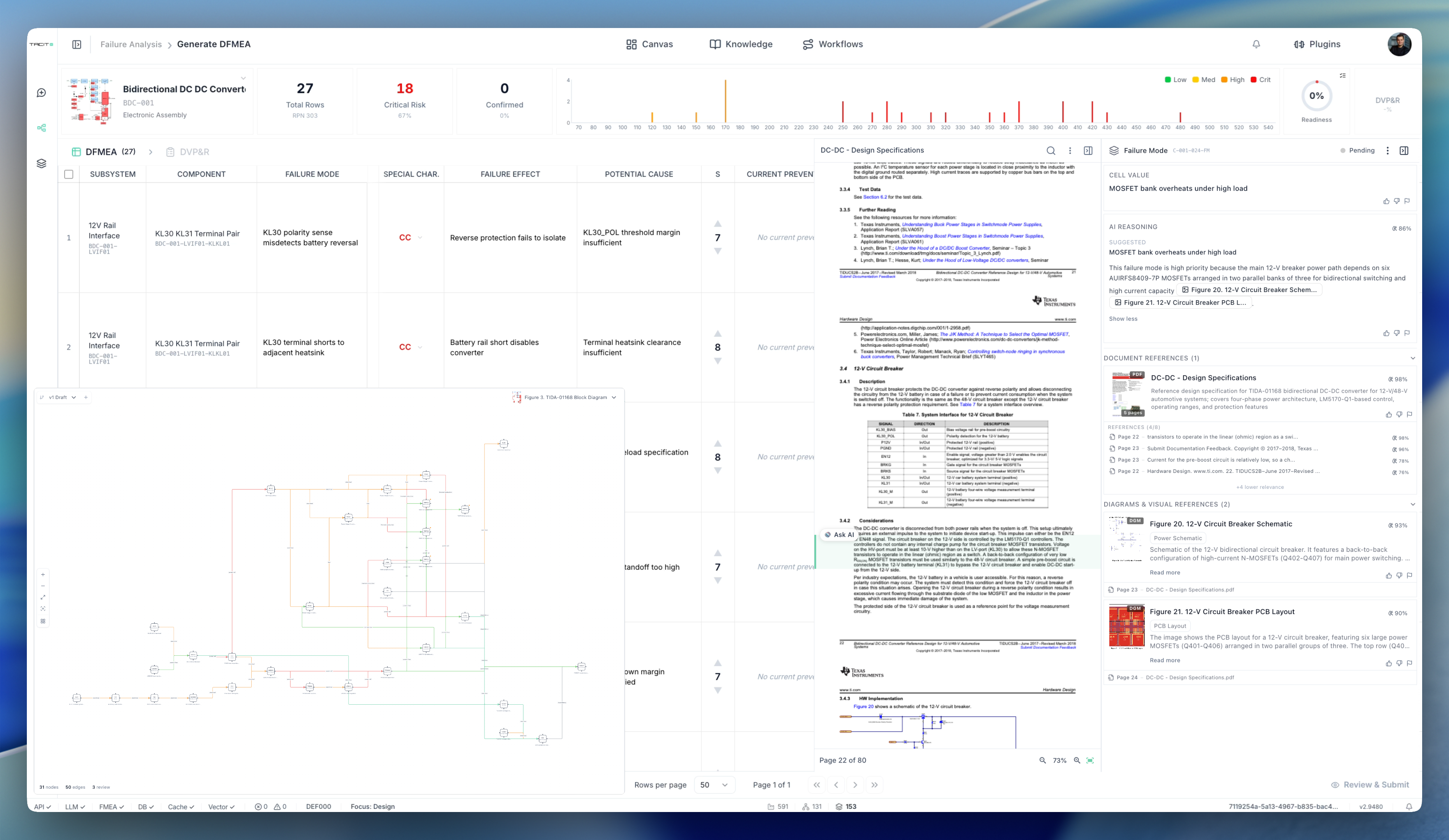
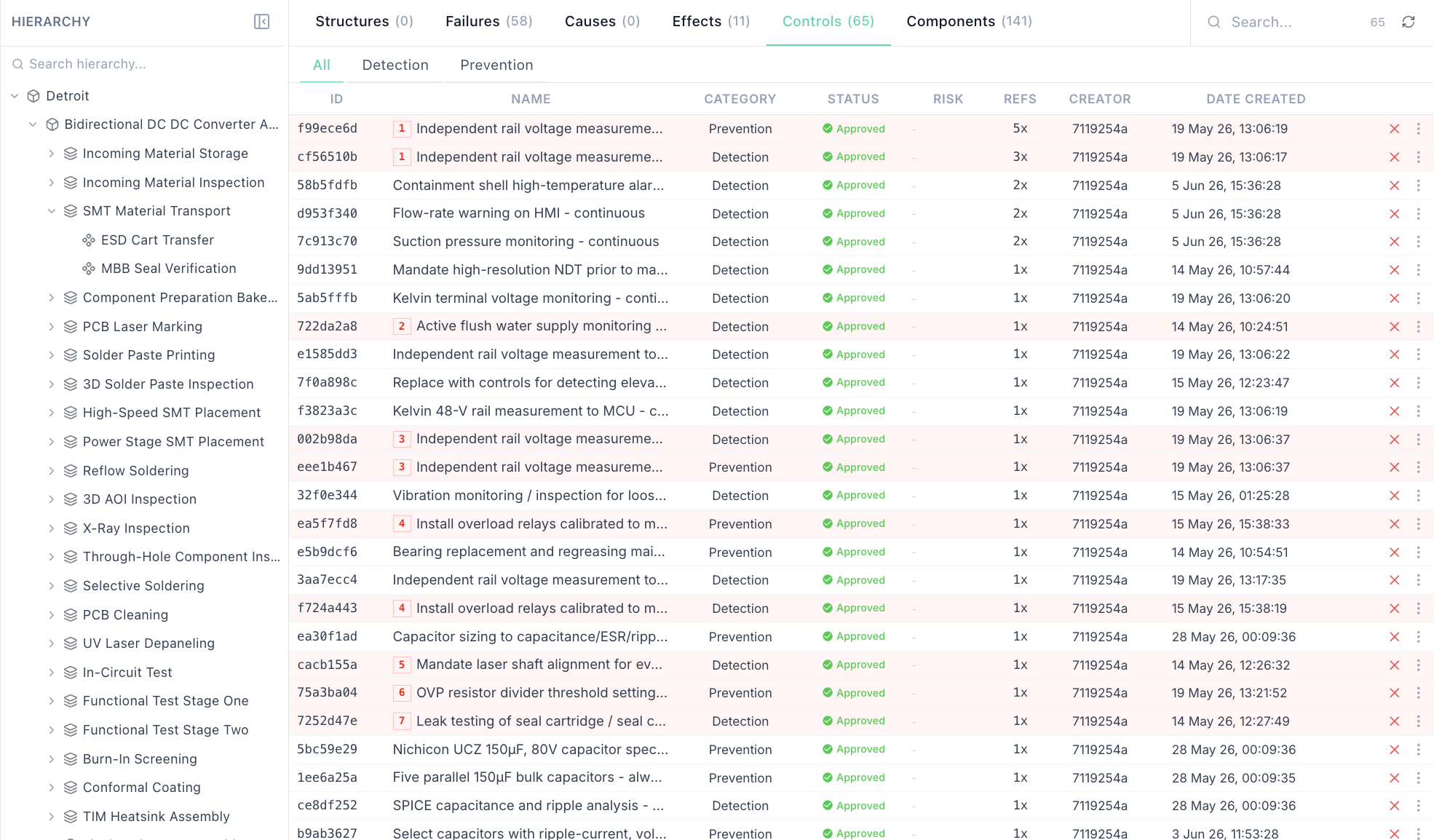
Tacit AI DFMEA workspace: failure modes generated from design specs with AI reasoning and source traceability
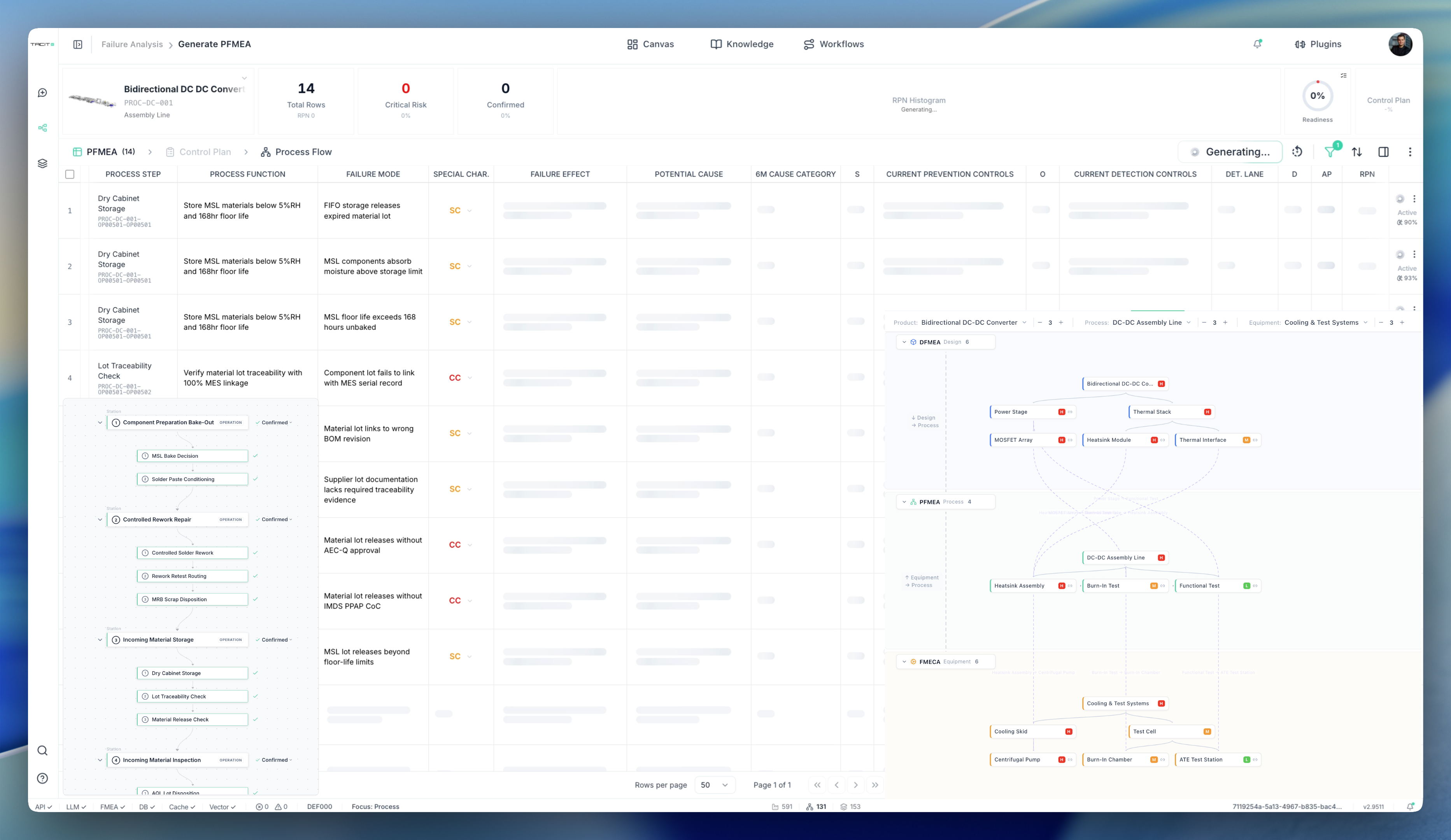
Tacit AI PFMEA workspace: process steps, 6M cause analysis and control plan links
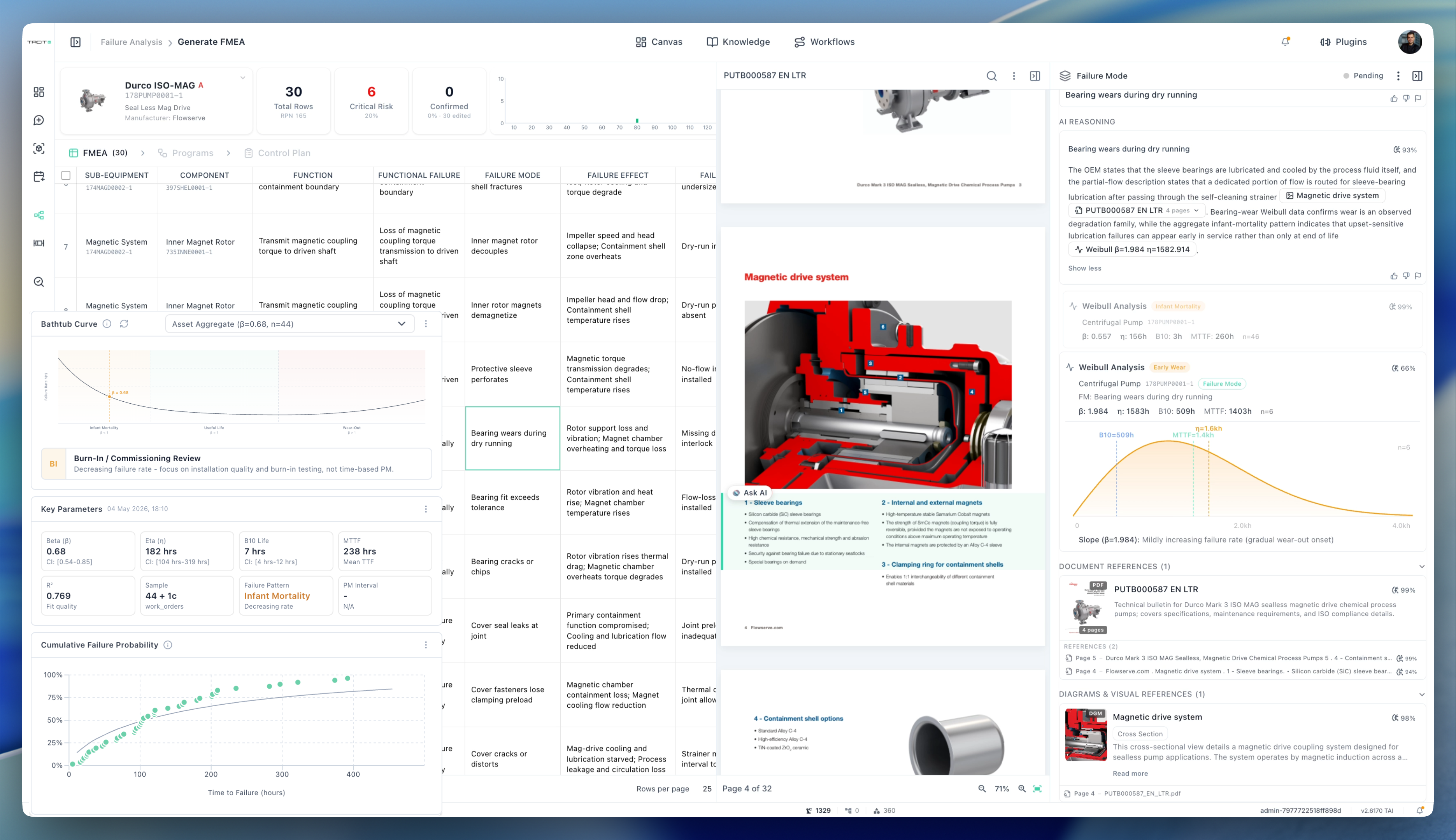
Tacit AI FMECA and reliability workspace: Weibull analysis, criticality and work-order feedback


Up to $24 billion. 67 million inflators recalled.

The evidence existed for years before anyone connected it. Takata, 2008-2024.

Warranty claims, work orders, supplier escapes, and field complaints lived outside the risk model until it was too late.


⚠︎

⚠︎

The Gap
Your risk model changes slower than reality.
Design assumes how the product will be built. Process assumes how the design will behave. Maintenance and field data reveal what actually happens. Too little of it flows back.

*Observed across engagements with pharma, automotive, mining, and industrial manufacturers.


Results from current enterprise deployments

Always current
updates when data changes
All deployments
100%
traced to source documents
All deployments
>30%
engineer task time reduction
Production deployments
80-95%
engineer-level accuracy
Production deployments
10×
more systems, same team
Across all deployments
<3 weeks
vs. 12 months manual
Across all deployments

"The combination of AI-generated FMEAs, data quality scoring, and source traceability is unlike anything else available."

Global Reliability & Maintenance Lead, Global Pharmaceutical Group

The platform

Everything you already have.
Turned into risk strategy you can defend.


Click to pause


How it works

One system. Three weeks. Measured value.

Typical scoped pilot. Final timing depends on source access, system complexity, and reviewer availability.

DAY 1

Scope decision

Agree the system, baseline, sources, reviewers, and success criteria.

DAYS 2–5

Connect evidence

Score data quality, structure records, and preserve source links.

DAY 7

Deliver draft

Receive cited failure patterns, coverage gaps, and draft analysis.

WEEK 2

Engineer review

Accept, revise, or reject each proposal and record why.

WEEK 3

Measure value

Compare coverage, review effort, acceptance, and decision value.

ONGOING

Govern changes

New evidence creates review flags; controlled records change after approval.
From our clients

What engineering teams are saying.

"We evaluated Tacit AI for Design FMEA on a critical power electronics subsystem. The structured output and the approach to connecting information exceeded expectations. We're proceeding with a formal pilot."
Design FMEA
Proceeding to pilot

"We can draft multiple FMEA per day, compared to one every week before Tacit AI. The improvement in data quality and standards helps us accelerate improvements."
1/week → multiple/day
83% data quality. 26% PM eliminated.

"Tacit AI helped us access manuals, drawings, and procedures instantly, reducing desk trips. Field teams spend more time on assets, improving work cycle and wrench times. The rolling mill pilot is just the beginning in our digital transformation journey."
42 min saved per repair
+13% wrench time

"Without Tacit AI, the critical gaps hidden in 19,000 work orders would have stayed invisible. The 2.7x data quality improvement was just the beginning."
2.7x data quality
19K work orders processed

"We have 30,000 functional locations across 10 offshore platforms. Organizing strategies manually would take years. When we saw the automated failure-mode mapping and PM effectiveness tracking - it was like a miracle."
Years → weeks
30K assets covered

"Where AI can really help us is studying data from multiple sites in multiple languages to identify common failure patterns. That has a lot of value."
Cross-site patterns
40+ languages

"The benefit of using AI is to find 100,000 $100 improvements. We have no practical means to do that manually. It's not possible."
100K × $100 gains
Not possible manually

"I've been evaluating top-quartile solutions for the past year. Even the best ones don't have what Tacit AI offers. The combination of AI-generated FMEAs, data quality scoring, and source traceability is unlike anything else available."
1 year eval
Nothing compares

"We tested Tacit AI to build an FMEA for a critical screener. We gave it troubleshooting and maintenance PDFs, a BOM in Excel and a few sentences of context. The output was an 80-90% ready FMEA with mitigating tasks, work instructions and clear AI reasoning that our engineers could quickly adapt and load into our reliability system."
80-90% draft-ready
Days vs months

"Tacit AI flags complex bad actor patterns our team missed. The context graph connects work orders, manuals, and failure modes automatically."
Repeat failures surfaced
Cross-WO linkage

"From 10,000+ work orders and 100+ manuals, Tacit AI surfaced 56 data quality and failure attributes we had no visibility into. First actionable results came within 4 weeks."
10K+ work orders processed
Results in 4 weeks

"Tacit AI is a fantastic solution for quickly getting to a high-quality FMEA without a heavy resource load on our Reliability Engineers."
80-90% draft-ready
Days, not months

"Technically, it convinces me. I know this is the future of maintenance management. We spent six months on one machine's RCM and still aren't finished. This compresses that to days."
6 months → days

"As a small manufacturer, quick time to ROI and efficient resource allocation are top of mind. Tacit AI helped our technical team complete months of work in Week 1."
Months → Week 1

"We are now able to prevent failures from happening and do work much faster than before. The morale of our small technical team went up because they now see the value of the data they collect in the CMMS."
-37% repair cycles
ROI in Week 1

"We spent six months on one machine's RCM and still aren't finished. This compresses that to days."

Maintenance Coordinator, Global Cement - Kiln & Mill RCM

Your team

One governed risk workflow for engineering, quality, and leadership.

Design Engineer view - DFMEA generation with source documents, failure mode analysis, and evidence citations
Process Engineer view - PFMEA generation with process flow, failure modes, and connections canvas
Reliability Engineer view - FMEA with Weibull analysis, bathtub curve, failure probability, and document traceability
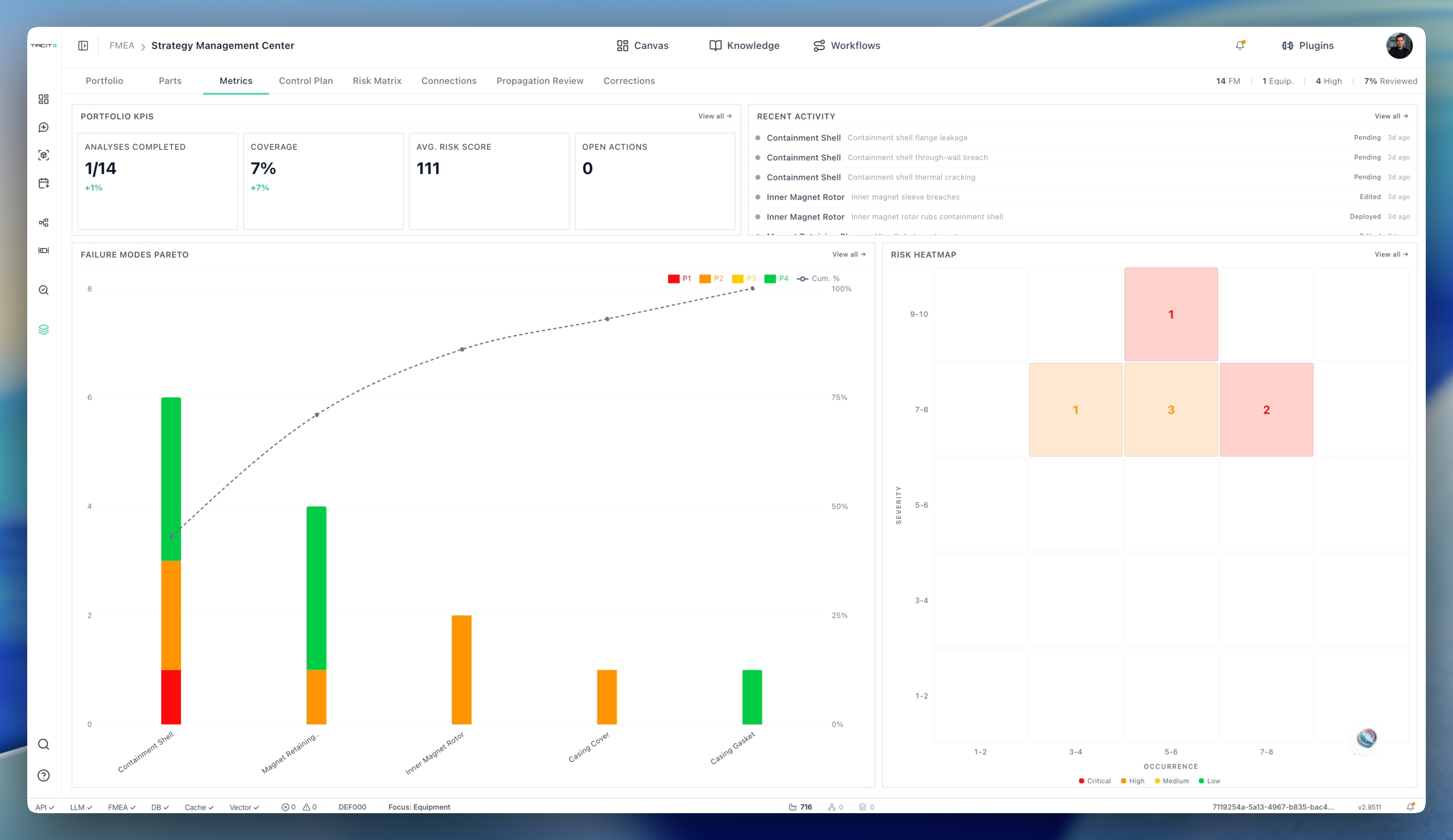
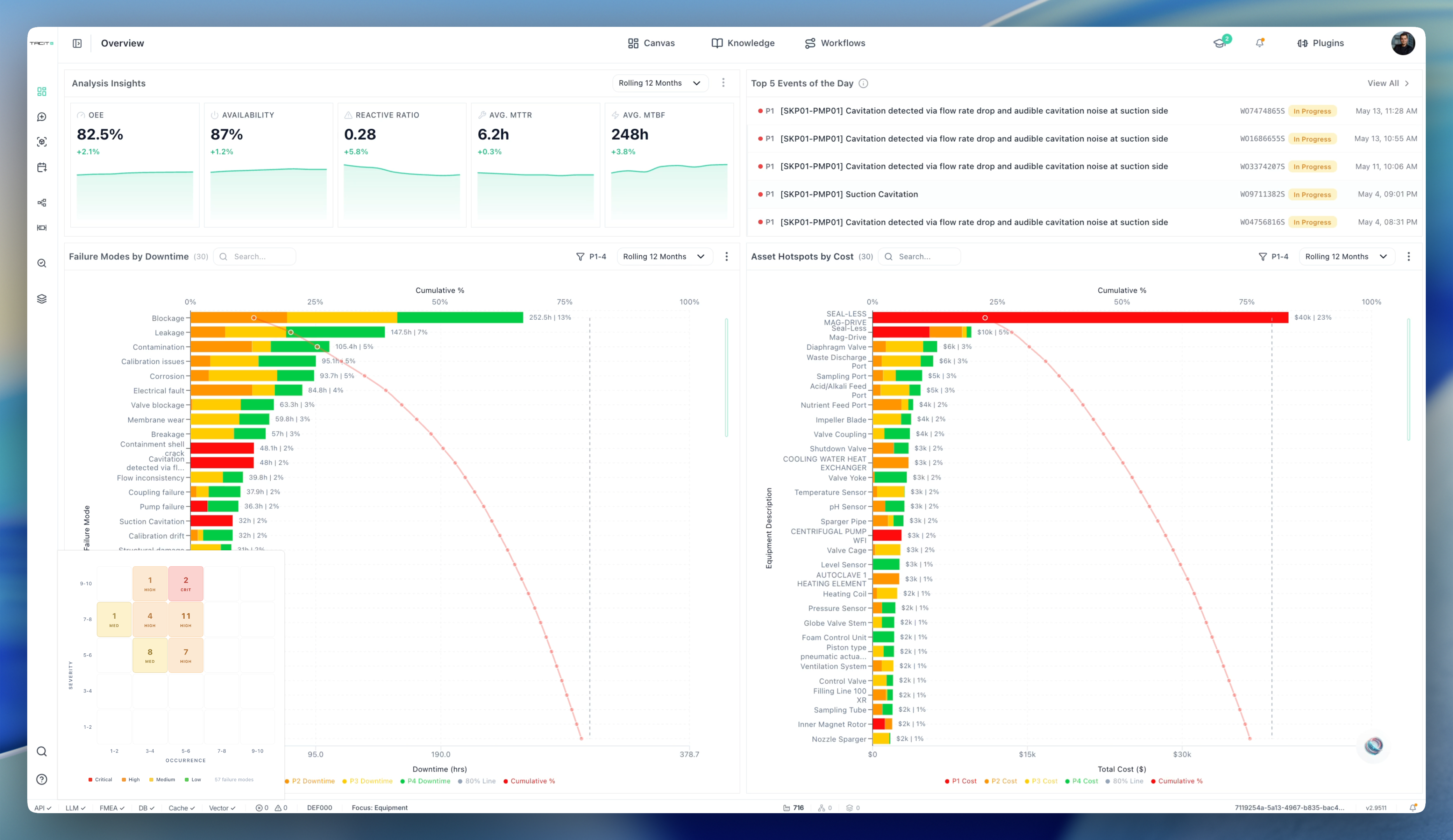
Engineering Manager view - Strategy Management Center with portfolio KPIs, failure mode Pareto, and risk heatmap
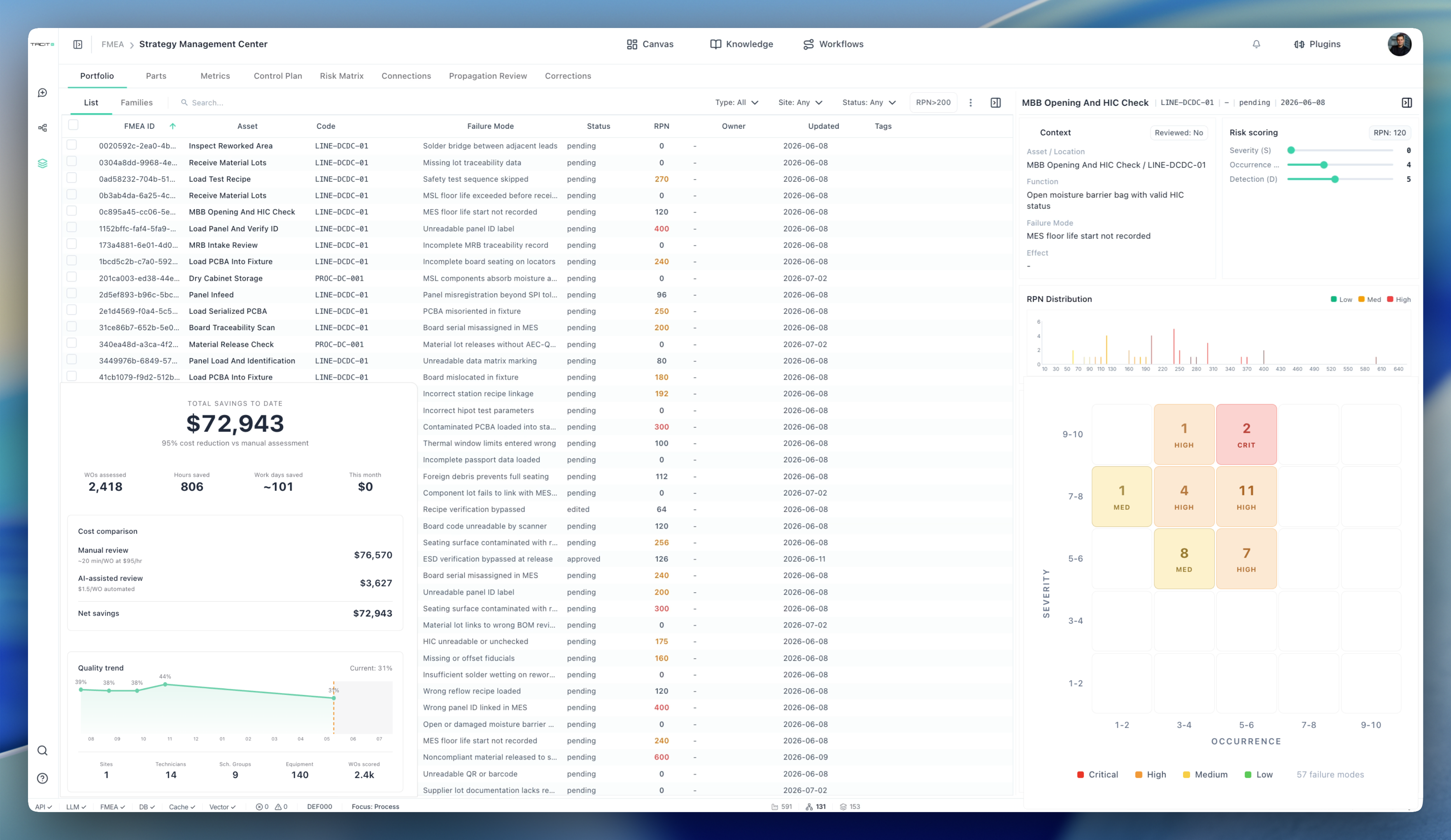
Quality and Compliance view - FMEA portfolio with traceability, RPN distribution, and risk scoring
VP and Plant Leadership view - Asset Performance Optimization with availability heatmap, MTTR and MTBF trends, and recommended actions
Enterprise control

Deploy where your enterprise approves.

Choose VPC, on-premise, or an isolated hosted deployment. Keep engineering authority, source evidence, access policy, and release decisions under your control.

01

Human Approval

AI output remains a proposal until an authorized reviewer accepts it. Row-level decisions are versioned, attributed, and reversible.

02

Private Deployment

Run in your VPC or on-premise with a dedicated database, or assess an isolated hosted option. Retain structured logs, access controls, and review evidence.

03

Exportable Evidence

Export proposed content with citations, confidence indicators, reviewer decisions, and change history. Audit activity by user, system, and operation.

04

Portable Knowledge

Failure libraries, approved corrections, and applicability rules remain structured customer data. Export them at any time and change model providers without rebuilding the risk baseline.

Enterprise FAQ

The technical and commercial questions that matter.

No. Tacit AI prepares cited analysis and specific change proposals; qualified engineers determine scope, ratings, controls, applicability, and release. Every accepted or rejected proposal is attributed and versioned. The value is leverage: specialists review structured evidence instead of assembling the first draft manually.

Your messy data is the input, not the obstacle. One customer went from 32% to 73% completeness in the first pass. Data quality is scored field by field—you see exactly where the gaps are before anything else happens. Messy records, PDFs, spreadsheets: all accepted. For greenfield with no operational history, design specs, BOMs, OEM manuals, and industry failure libraries are the starting point. See how standardization works

Keep them. Tacit AI compares existing analyses with approved work orders, failure history, inspection results, and source documents. The review package surfaces possible missing failure modes, unsupported ratings, stale assumptions, and controls that may warrant reassessment. Your team decides whether the controlled analysis changes.

Generic assistants can produce plausible text, but they do not provide a governed engineering workflow. Tacit AI links proposed rows to page-level evidence, scores source quality, applies controlled taxonomies, records reviewer decisions, and flags source changes for reassessment. See the full comparison

Choose VPC deployment on Azure, AWS, or GCP, on-premise installation, or an isolated hosted option. VPC and on-premise deployments keep data inside your approved boundary; each customer has a dedicated database. Encryption at rest and in transit, MFA, RBAC, audit logging, and full data export are supported. Disconnected deployment is assessed against the customer's infrastructure and authorization requirements.

Start with one system and named reviewers. Deliver cited output in familiar formats such as Excel or PDF, or use a controlled PLM/CMMS integration after validation. Measure corrections, acceptance, review effort, and decision usefulness before expanding. If the output does not meet the agreed standard, the pilot stops.

Tacit AI preserves the evidence and decisions that were actually recorded: source citations, corrections, reviewer dispositions, applicability rules, and change history. It does not invent rationale that was never documented; it flags the missing support for expert resolution. That gives the next engineer a reviewable trail instead of an unexplained spreadsheet.

The pilot starts with your baseline: current engineering hours, analysis backlog, review cycle, repeat-event cost, or production exposure. Tacit AI reports observed review effort, accepted coverage, and decision value for the selected system. The expansion case uses your measured results—not a generic ROI assumption.


Pick one critical system.
See the failures nobody connected.

Bring one document. See the gaps. 30 minutes.

"We evaluated Tacit AI on a critical subsystem. We're proceeding with a formal pilot."

Design Engineer, Top 10 Global OEM - FMEA, Europe

Privacy Settings
We use cookies to enhance your experience while using our website. If you are using our Services via a browser you can restrict, block or remove cookies through your web browser settings. We also use content and scripts from third parties that may use tracking technologies. You can selectively provide your consent below to allow such third party embeds. For complete information about the cookies we use, data we collect and how we process them, please check our Privacy Policy
Youtube
Consent to display content from - Youtube
Vimeo
Consent to display content from - Vimeo
Google Maps
Consent to display content from - Google
Spotify
Consent to display content from - Spotify
Sound Cloud
Consent to display content from - Sound