

A recall is supposed to end a failure mode. In 2026, 41 vehicle recalls exist because an earlier recall did not. We read every 2026 vehicle recall in NHTSA’s public recall file, 716 of them, and the Part 573 report behind each one that points back to an earlier recall.
This post is for the quality and field engineers who own the PFMEA and the warranty data. It shows how often the fix fails, how long it takes to see it, and the row in the FMEA that should have moved first.
The numbers
- 41 of 716 vehicle recalls filed in 2026 up to 12 November (5.7%) repair an earlier recall whose remedy did not hold. Together they cover about 3.5 million vehicles.
- 18 remedies did not stop the failure. 18 were carried out wrong: a wrong part, missing software, an incomplete inspection. 4 used a defective remedy part. 1 remedy caused a new fault.
- 637 days is the median gap between the earlier recall and the new one. For remedies that did not stop the failure, it is 565 days.
- Another 28 recalls (3.9%) expand an earlier recall to more vehicles.
What the Data Shows
The 41 recalls split into 2 kinds of failure, and they need different rows in the FMEA.
- The remedy design was wrong (19 recalls). The fix did not stop the failure mode, or it created a new one. These cover about 3 million vehicles, nearly all of the total.
- The remedy was carried out wrong (22 recalls). A wrong part, missing software, an incomplete inspection, or a defective part shipped as the fix. 9 of these came from 1 manufacturer’s audit, filed on the same day, of software updates that may never have been installed.
Electrical systems lead with 10 recalls, then powertrain with 5, rearview cameras with 4, and suspension and steering with 3 each. NHTSA’s defects office influenced 5 of the 41. The other 36 came from the manufacturers themselves.
Without the 9 audit recalls, the rate is 32 of 716 (4.5%) and the median gap is 425 days. Either way, the second recall arrives more than a year after the first one was meant to close the issue.
Case 1: Seat Fires After the Repair
A 2024 recall addressed a fire risk at the front power seat motor of a 3-row SUV. The first report of a fire on a repaired vehicle came 4 months after the recall. The new recall came 20 months after that first report.
- 5 Jun 2024The first recall is filed for a potential fire risk at the front power seat motor (chronology, p. 1).
- 17 Oct 2024First report of a fire under the passenger seat “after completion of 24V407 recall repair” (chronology, p. 1).
- 8 Apr and 2 May 2025A 2nd and a 3rd report of the same failure on repaired vehicles (chronology, p. 1).
- May and Jun 2025Inspections find “sporadic dealer workmanship issues” (chronology, p. 1).
- Jun 2026Field data analysis counts 18 unique incidents, 7 seat fires and 11 melted seat motors, received from October 2024 to April 2026. The manufacturer recalls the vehicles “previously recalled”: 462,869 of them (chronology, p. 1) (Part 573, p. 1).
Case 2: 2 Remedies on the Same Axle
A trailer maker recalled the same axles twice. 3 more post-remedy failures turned up in routine claim reviews within 3 months of the first report. The data that proved the remedy insufficient came 1 year later.
- Jul 2023 and Mar 20242 recalls on the same trailer axles, each with its own remedy.
- 25 Jan 2025First notice of “a post remedy failure” on a recalled axle (Part 573, p. 4).
- Jan to Apr 2025“During routine claim reviews”, 3 more post-recall incidents are found (Part 573, p. 4).
- 10 May 2025An owner complaint to NHTSA reports the same condition after the 2nd recall (Part 573, p. 5).
- 5 Jan 2026Tests show the remedy under both recalls “is not sufficient to prevent spring slip” (Part 573, p. 5).
- 15 Jan 2026A new recall covers “the entire previously addressed population” with “an improved and more robust remedy” (Part 573, p. 5).
In both cases the manufacturer found the signal in its own records: dealer cases, claim reviews and owner complaints. The mint marks show where each record met a risk row that assumed the remedy worked.
The Row That Should Have Moved
Below is a typical PFMEA row for the remedy process, built only from facts in the seat case. It is an illustration, not the manufacturer’s analysis.
| The row as written | The row kept up to date | |
|---|---|---|
| Process step | Install the recall remedy at the dealer | Same |
| Failure mode | Remedy installed wrong, or installed right and does not stop the failure | Same |
| Effect | The original hazard returns on a vehicle the owner believes is fixed | Same |
| Cause | Workmanship variation at the dealer, remedy not tested against the field failure | Workmanship variation confirmed by inspection of repaired vehicles |
| Prevention control | Service procedure and technician instructions | Procedure changed to remove the variation, remedy validated against the field failure |
| Detection control | Remedy completion recorded | Every complaint, claim and field report on a repaired vehicle matched to this row |
| Evidence | None linked | 3 reports of fire on repaired vehicles in 7 months |
| Severity (S) | 10 | 10 |
| Occurrence (O) | 2 | 6 |
| Detection (D) | 4 | 7 |
| Action priority | Low | High |
As first written, the row assumes the remedy works: occurrence is rare and completion is the control, so the action priority is Low. 3 reports of fire on repaired vehicles in 7 months contradict that occurrence rating, and completion records cannot detect a remedy that fails in use. Kept up to date, the same row is High, and a High row needs an action or a documented reason.
How a FMEA That Stays Up to Date Handles a Remedy
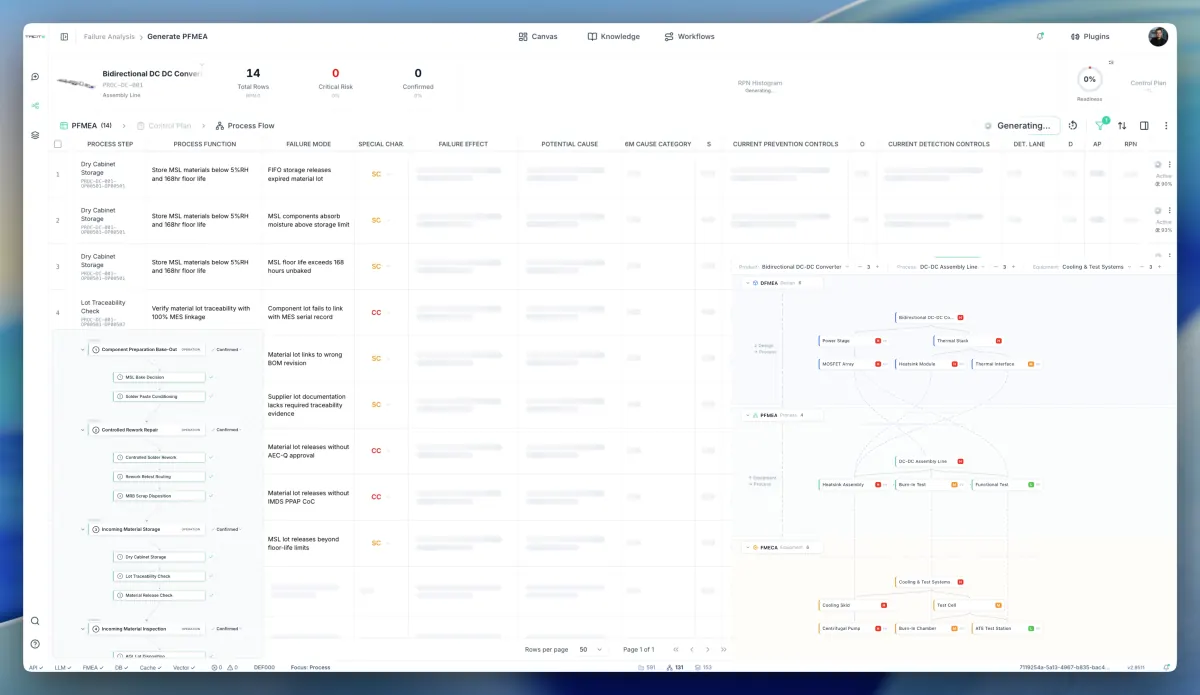
- Treat the remedy as a process. Tacit AI builds the remedy’s PFMEA rows from the recall instructions and the original DFMEA and PFMEA rows, so workmanship, part and software causes each have a row and a control.
- Watch repaired units separately. Claims, complaints and field reports on repaired vehicles are matched to the remedy rows, not lost in the general warranty count.
- Flag the 1st contradiction. The first failure on a repaired unit contradicts the occurrence rating. Tacit AI flags the row and proposes the new rating, with the records behind it.
- An engineer decides. The owner approves or rejects each change, and the decision is recorded with its evidence for the next audit or NHTSA question.
Check Your Own Recalls and Field Actions
- List every recall and field action of the last 3 years with its remedy.
- For each remedy, find the PFMEA rows for the repair process. No rows means no control on the fix.
- Pull every claim, complaint and field report on a repaired unit. Count them per remedy.
- Compare each count with the occurrence rating on the remedy rows. Any repeat with an unchanged rating is a gap.
- For remedies done by dealers or service partners, check that workmanship has a row and a detection control beyond completion.
Same failure, another fix?
Get the 12-month 8D review sheet: find the repeats, the read-across nobody did and the fixes nobody verified.
We email you the PDF. No newsletter. Privacy policy
Method
Source: NHTSA’s public recall file for recalls since 2010 (FLAT_RCL_POST_2010), with its field layout (RCL.txt). We kept vehicle recalls with a Part 573 report received from 1 January 2026 and counted each campaign once: 716 recalls, the latest received on 12 November 2026.
A first pass searched the defect, consequence, remedy and notes text for earlier campaign numbers and remedy wording, and found 95 candidates. We read every candidate, then the latest Part 573 report of each recall that points to an earlier one. A recall counts as “remedy did not hold” when vehicles already repaired under an earlier recall need a new remedy. A recall that only adds vehicles counts as an expansion. Gaps are measured between the Part 573 received dates of the 2 recalls. Vehicle totals are the manufacturers’ estimates, and 1 recall that sits inside another is counted once in the 3.5 million.
Bring 1 recall or field action and its claims. Book a working session and see the remedy rows built, with every claim on a repaired unit linked to its row.
Frequently Asked Questions
How many 2026 vehicle recalls repair an earlier recall?
41 of the 716 vehicle recalls filed with NHTSA in 2026 up to 12 November (5.7%) cover vehicles already repaired under an earlier recall whose remedy did not hold. Another 28 expand an earlier recall to more vehicles.
Why do recall remedies fail?
In the 2026 data, 18 remedies did not stop the failure mode, 18 were carried out wrong (wrong part, missing software, incomplete inspection), 4 used a defective remedy part and 1 caused a new fault.
How long does it take to recall a failed remedy?
The median gap between the earlier recall and the new one is 637 days in 2026, and 565 days where the remedy did not stop the failure.
Does a recall remedy need its own PFMEA?
Yes. A remedy adds a new part, procedure or supplier, and often a new place where the work is done. Each brings causes the original PFMEA never covered, from dealer workmanship to software that is never installed.
How does Tacit AI catch a remedy that does not hold?
Tacit AI builds the remedy’s PFMEA rows, matches every claim, complaint and field report on a repaired unit to them, and flags the row with a proposed rating change at the first contradiction. The engineer approves each change. See our automotive FMEA software.
Sources