

Relyence FMEA Alternative: From AI Suggestions to the Full FMEA, Built From Your Evidence
Relyence FMEA is a cloud reliability suite that many quality and reliability teams like: broad standards, clean worksheets, and an AI panel that suggests content. The suggestions come from the worksheet you already started. The evidence that should shape the FMEA sits elsewhere.
Tacit AI builds the full DFMEA, PFMEA, FMECA and control plan from your own specs, drawings, process flows, test results and 8Ds. Every row is traced to its source, and your engineers review and approve. It is deployed at global automotive OEMs and Tier 1 suppliers.
The short version
- Relyence covers the standards and keeps process flow, PFMEA and control plan in sync.
- Its AI suggests functions, failure modes, effects and causes from your analysis tree. Tacit AI builds the whole FMEA from your documents.
- A Top 20 Global OEM builds FMEAs 8× faster with Tacit AI.
- Keep Relyence as your record. Your FMEAs come in from it, nothing has to move.
What Relyence FMEA Does Well
- Standards. SAE J1739, ARP5580, AIAG, AIAG & VDA, MIL-STD-1629 and IEC 60812, plus Ford, GM and Stellantis requirements (Relyence brochure).
- The linked set. DFMEA, PFMEA, FMEA-MSR, FMECA, DVP&R, process flow and control plan in 1 product, with the process documents kept in sync (product page).
- Reuse. Knowledge Banks hold foundation FMEAs that new analyses draw on (Relyence guide).
- Deployment choice. On-premise, private cloud or Relyence cloud, in the browser.
Suggest or Build: What the AI Does
Relyence names the feature AI-Assisted FMEA Generation. Suggestions are generated “directly from your FMEA Worksheets” and delivered in the SmartSuggest panel, “where you can review, refine, and selectively apply” them (SmartSuggest). Its 2026 release says it is powered by ChatGPT and works from your analysis tree, selected worksheet fields and FMEA type (Relyence 2026).
That is a general model filling cells from the tree you started. It helps an engineer who is already writing. Tacit AI starts somewhere else:
- From your evidence. Specs, drawings, process flows, test results and 8Ds, not the tree alone.
- The whole FMEA. Structure, failure chains, controls and ratings, built to your standard before the first review.
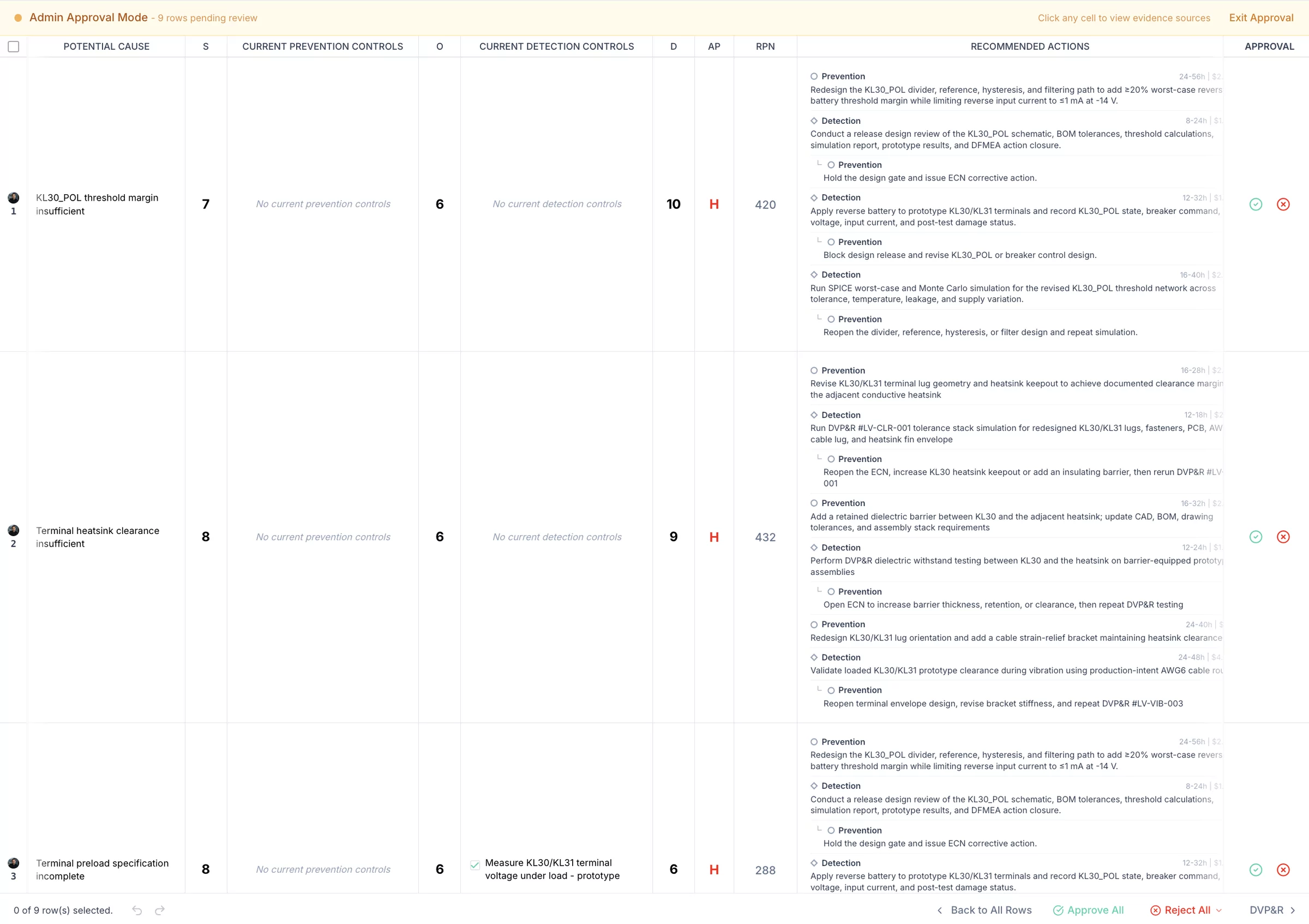
- A source on every row. Click a cause and see the page or record it came from. That is what an auditor asks for.
Why a general model alone falls short on reliability work: why ChatGPT fails at industrial reliability.
Relyence FMEA vs Tacit AI
| Relyence FMEA | Tacit AI | |
|---|---|---|
| Who writes the FMEA | Your engineers, with suggestions | Tacit AI builds it, engineers approve |
| AI | Suggests from your analysis tree | Builds the full FMEA from your documents |
| Source per row | Not published | Every row traced to its source |
| FRACAS and CAPA to FMEA | Matched failures connect, new ones go to the FMEA team | Matched to rows, ratings and new rows proposed |
| 8Ds and complaints | Not published | Matched to rows, changes proposed |
| Control plan | In sync with PFMEA | Built from the PFMEA rows, alignment checked |
| Standards | J1739, AIAG-VDA, MIL-STD-1629, IEC 60812 | AIAG-VDA, J1739, IEC 60812, MIL-STD-1629A, ISO 14971 |
| Time to first FMEA | Not published | Days. Setup in hours |
Relyence’s FRACAS link is described on its Failure Direct Connect page: a failure that matches the FMEA connects to it, and a new failure mode sends a request to the FMEA team.
How Tacit AI Builds the FMEA
- Connect. Specs, drawings, process flows, test results, 8Ds and failure reports. Your FMEAs come in from Relyence as files. Setup in hours.
- Build. The full FMEA to your standard, every row traced to its source. The first FMEA arrives in days, 80-90% engineer-ready on first delivery.
- Approve. Engineers review each row, accept or change it, and every decision is recorded.
- Keep up to date. New 8Ds, complaints and test results flag the rows they change, with the change proposed.
Keep Relyence as Your Record
- Your FMEAs come in from Relyence as files.
- Approved changes export to Excel for your Relyence team.
- Read-only access, nothing to migrate.
Comparing FMEA tools?
Get the scorecard to rate any FMEA tool, yours included.
We email you the PDF. No newsletter. Privacy policy
Other Alternatives
Each comparison uses only the vendor’s own pages:
- ReliaSoft XFMEA alternative
- Windchill FMEA alternative
- Omnex AQuA Pro alternative
- APIS IQ alternative
- Best AI tools for FMEA, 10 compared on what their AI does
Bring 1 FMEA from Relyence and the documents behind it. Book a working session and see the full FMEA built from them.
Frequently Asked Questions
Is there an AI alternative to Relyence FMEA?
Yes. Tacit AI builds the full DFMEA, PFMEA, FMECA and control plan from your own documents, every row traced to its source. Relyence’s AI suggests entries inside the worksheet.
What does Relyence SmartSuggest do?
It generates suggested functions, failure modes, effects and causes from your analysis tree, worksheet fields and FMEA type, and you choose which to apply. Relyence says it is powered by ChatGPT.
Can Tacit AI import FMEAs from Relyence?
Yes. FMEAs come in from Relyence as files. Approved changes export to Excel.
Does Tacit AI handle FMECA and FRACAS data?
Yes. Tacit AI builds FMECAs and matches failure reports, 8Ds and complaints to the rows they touch, with the change proposed to the owner.
How fast is the first FMEA?
Setup takes hours. The first FMEA is built in days, 80-90% engineer-ready on first delivery.
Sources
- Relyence FMEA brochure, Relyence, 2026
- Relyence FMEA, Relyence
- A guide to AIAG & VDA FMEAs in Relyence, Relyence, May 2022
- FMEA SmartSuggest, Relyence
- Welcome to Relyence 2026, Relyence, March 2026
- Failure Direct Connect, Relyence